Last month, a long-standing client in Stuttgart called our engineering desk with an urgent crisis. They were running a batch of D2 automotive stamping dies that had been vacuum-hardened to 60 HRC. The print called for several late-stage clearance and ejector holes. The shop burned through three sets of premium cobalt tooling at rock-bottom surface footage. None survived past hole two; one tip welded directly into the cavity, forcing an emergency wire EDM setup just to burn out the broken carbide.
This headache is all too common across North American and European toolrooms alike. Whenever a print calls out through-hardened D2 or A2, machinists brace for high tool wear and sudden failure. These high-carbon, high-chromium grades pack dense clusters of abrasive carbides with miserable thermal conductivity. Cutters overheat, the workpiece work-hardens on contact, and cutting edges shatter. Many machinists ask us: what’s the best drill bit for hard steel? Can an off-the-shelf coated drill reliably handle these cuts without destroying expensive workpieces?
In reality, penetrating hardened alloy steel takes far more than just grabbing a tool labeled as a drill bit for hard steel. Without sub-micron substrate toughness and a dedicated micro-chamfer (K-land) on the cutting lip, hard particles will crush the cutting edge on contact. Add even three tenths (0.0003″) of spindle runout, and the tool snaps instantly. In serial production, blind trial-and-error quickly turns into scrapped tooling, lost machine time, and sky-high cost per hole.
If your shop runs 58 to 62 HRC tool steels, are you still battling edge chipping, work hardening, and slow burns on the EDM bench?
Why Do Workshops Break Tools on Hardened D2/A2? The Logic Behind the Right Drill Bit for Hard Steel
Whenever we inspect broken tools returned from European or US plants, the root cause is rarely poor dynamic balance or aggressive feeds. Put the tip under a microscope, and you see clear signs of cleavage fracture rather than steady abrasive wear. The cutting lip takes brutal micro-impacts and massive thermal spikes during the first few milliseconds of contact. The carbide matrix simply fractures before the chip can form cleanly.
Drilling hardened cold-work steels is a constant fight between edge toughness and abrasive resistance. D2 carries 12% chromium, while A2 carries 5%; both form dense martensitic structures with low thermal conductivity. Cutting heat stays right at the chisel edge instead of transferring into the chip. If an operator drops spindle speed without adjusting the chip load, mechanical resistance spikes, and even a top-shelf drill bit for hard steel will bind and snap in the cut.
Micro-Damage Mechanism of Chromium Carbides (Cr-Carbides) on Hard Steel Drill Bits
Magnify a block of quenched D2 or A2, and you will find hard primary chromium carbides exceeding 70 HRC embedded across the matrix. It is the metallurgical equivalent of drilling cured concrete mixed with silica sand. Each time the cutting edge sweeps across the cut, these microscopic stones hammer the carbide face. If a standard tool has a sharp, unmodified cutting edge, this high-frequency impact quickly pulls grains out of the binder phase, triggering instant micro-chipping.
Once a micro-notch forms on the lip, tool balance collapses immediately. Contact friction surges, the cut work-hardens in fractions of a second, and thrust forces spike. That dull, droning hum from the spindle is not just cutting noise—the undissolved carbides have completely ground down the primary relief. The tool stops cutting and starts violently extruding the stock, guaranteeing that your hard steel drill bits snap on the very next spindle rotation.
Common Mistake: Selecting the “Best Drill Bit for Hard Steel” Using Pre-Hardened Steel Logic
During shop audits from Michigan to Bavaria, we often see teams run into trouble by treating 60 HRC tool steel like pre-hardened material. Operators frequently grab tooling tailored for 38–42 HRC pre-hardened slabs like P20 or 718H. Those tools use positive rakes and sharp edges for quick shear and chip flow. Put that geometry against quenched D2, and the thin edge collapses under the axial thrust, shearing off the outer margin instantly.
Many programmers also fall into the trap of assuming a high-heat coating fixes poor geometry. Pre-hardened and through-hardened steels place completely different loads on a tool. Finding the true best drill bit for hard steel is never about chasing a razor-sharp cut; it is about choosing a heavy-duty web, a sturdy negative K-land chamfer, and high-impact substrate toughness that can absorb severe mechanical shocks without chipping.
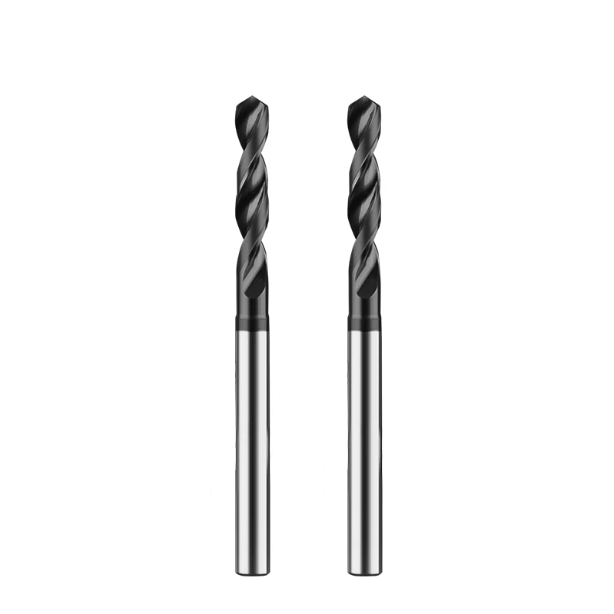
Real-World Validation: What’s the Best Drill Bit for Hard Steel (58-62 HRC D2/A2)?
Whenever a supervisor brings us a scrapped D2 insert or a print for review, the first question is always: what’s the best drill bit for hard steel? Our answer is pragmatic. In this hardness range, there is no magic bullet. Your success depends on machine-tool rigidity, holder quality, and heat-treat consistency. At 58 to 62 HRC, you walk a thin line between cutting and grinding; a variance of just two Rockwell points completely changes cutting-edge stress.
We run tool-life tests measuring axial thrust and vibration signatures in both our shop and customer plants. Drilling hundreds of holes in hardened tool steel is not about toughness alone, nor is it about chasing extreme hardness blindly. True tool performance relies on balancing structural rigidity with micro-geometry. Matching your tooling to the material’s actual microstructure is the only way to avoid chipping and maintain stable cycle times.
Beyond Cobalt Steel: Rigidity and Impact Resistance of Carbide Drill Bits for Hard Steel
We always steer machinists away from M35 or M42 cobalt tooling on 60 HRC D2. Cobalt HSS may offer good toughness, but its red hardness fails against through-hardened alloy steels. Spindle telemetry shows that cobalt edges soften within seconds of contact as tip temperatures cross 600°C. The drill deflects, the hole tapers, and the tool seizes in the bottom of the cut.
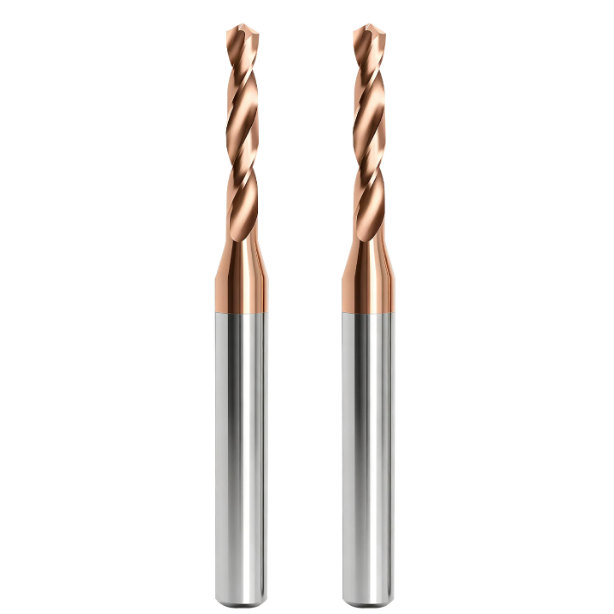
In contrast, carbide drill bits for hard steel feature an ultra-fine grain substrate with triple the elastic modulus of HSS. This exceptional flexural rigidity stops deflection and keeps the cutting edges tracking true against hard carbide inclusions. Solid carbide has lower impact toughness, requiring tight spindle tolerances. However, once runout is dialed in, it delivers bore tolerances and surface finishes that cobalt simply cannot match.
Extreme Hardness (60–64 HRC): Why We Switch to HRC65 Carbide Drill Bits
When core hardness crosses 60 HRC—especially on over-hardened batches reaching 62 to 64 HRC—we stop testing standard tools. At that stage, we move customers straight to dedicated hrc65 carbide drill bits. Conventional carbide contains too much cobalt binder, which erodes quickly against hard carbides. The tungsten grains pull out, and the cutting edge dulls long before chipping is visible to the eye.
These specialized tools use sub-micron tungsten carbide grains with minimal binder, reaching over 93 HRA hardness. They have zero tolerance for setup chatter or spindle play. But when held in shrink-fit or hydraulic chucks, their red hardness allows them to peel micro-chips under light feeds like miniature boring bars. This eliminates slow, costly EDM hole-burning entirely.
Point Angle (140°) and Micro-Chamfer (K-land): Engineering the Best Drill Bit for Hard Steel
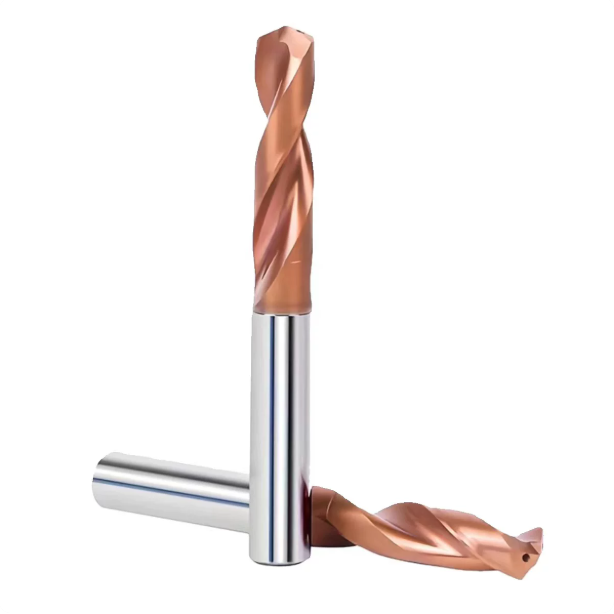
To many machinists, a drill looks like two flutes and a point. But on our 5-axis CNC grinders, the secret to the best drill bit for hard steel lies in the micro-geometry. Conventional 118° or 135° points load the fragile outer corners first, triggering corner blowouts. Our 140° point shortens the cutting edge’s moment arm and directs axial thrust straight into the rigid machine spindle.
Edge prep is equally critical. We never ship raw, ground cutting edges. Instead, we use abrasive brushes to prepare a controlled 0.02mm to 0.03mm negative chamfer (K-land). While some believe a honed edge increases cutting resistance, this micro-radius actually reinforces the cutting wedge. It prevents micro-fractures caused by hard chromium inclusions, keeping the cutting lip intact when penetrating hardened surfaces.
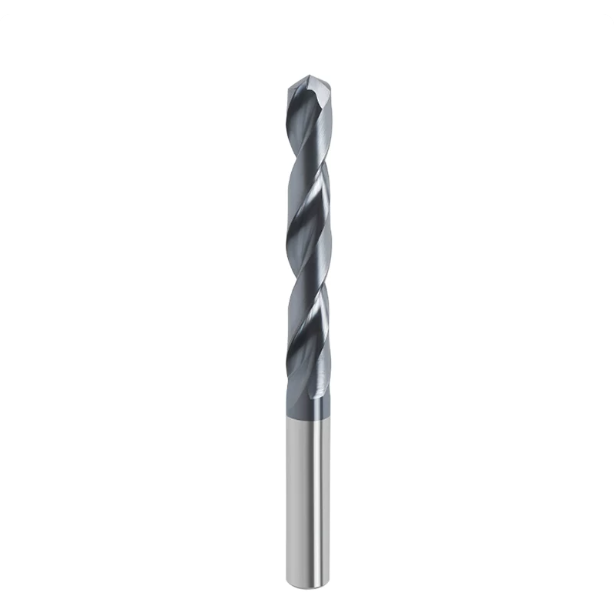
CNC On-Site Optimization: Tooling Standards for Carbide Drill Bits for Hard Steel
Even the highest-grade tools can be ruined in thirty seconds by poor machining parameters. When drilling 60 HRC D2 or A2 tool steel, process control and setup rigidity account for 70% of your results. Many shops blame tool quality after a failed trial. Yet nine times out of ten, dial indicators reveal that their runout and workholding fall short of standard requirements.
Dialing in cutting parameters is a delicate balance between work-hardening and thermal wear. Feed too slowly, and the lips rub, glaze the hole bottom, and induce secondary hardening. Feed too aggressively, and axial forces snap the core. To maximize your carbide drill bits for hard steel, you need a rigid setup, verified speeds and feeds, and effective coolant delivery to resist cutting forces.
Cutting Speed (Vc) and Feed (fn) Limits: Preventing Surface Work-Hardening
Machinists used to pre-hardened steels often run high surface footage to “power through” cuts. In hardened D2 or A2, that approach is fatal. Our tool-life logs show that cutting speed (Vc) must stay strictly between 15 and 25 m/min. Exceed 30 m/min, and cutting zone temperatures surge past 900°C. The carbide binder softens, leading to rapid crater wear and tool failure.
On feed rates (fn), our rule is simple: positive chip load beats rubbing every time. For 3mm to 8mm holes, feeding below 0.02 mm/rev causes the tool to ride on the hardened layer without shearing chips. Keeping feeds between 0.03 and 0.05 mm/rev lets the lip bite directly into fresh material below the glazed surface, preventing premature wear on hard steel drill bits.
Tool Holder Selection: Keeping Radial Runout Under 0.003mm (0.0001″)
In soft steels, 0.01mm (0.0004″) of runout on an ER collet is forgiving because the material yields. In 60 HRC tool steel, a runout of just 0.005mm means one cutting edge takes the entire mechanical load. This causes single-edge chipping, immediately followed by total core fracture inside the bore.
We advise customers to eliminate standard collet chucks and use hydraulic or shrink-fit tool holders. Always sweep the shank with a 0.001mm indicator at 3xD from the holder face. Total indicator reading (TIR) for your drill bit for hard steel must measure under 0.003mm. Balancing the chip load equally across both cutting lips is the key to preventing catastrophic brittle failure.
Coolant Delivery: High-Pressure Through-Coolant vs. MQL in Deep Holes
Beyond 3xD depth, coolant is primarily about chip evacuation rather than simple cooling. Flood coolant nozzles are ineffective in deep, hard steel holes; boiling fluid forms a vapor barrier, causing thermal shock and spider-web fractures. High-pressure through-spindle systems (minimum 30 bar; 50+ bar preferred) shatter chips on contact and blast them out of the flutes, preventing re-cutting.
For machines without high-pressure through-coolant, Minimum Quantity Lubrication (MQL) serves as a viable alternative. A high-pressure air blast carrying atomized lubricant lubricates the margin lands while clearing powdery chips. This near-dry method prevents the thermal shocks associated with water-based coolants, offering a stable cutting environment for standard-depth holes in hardened dies.
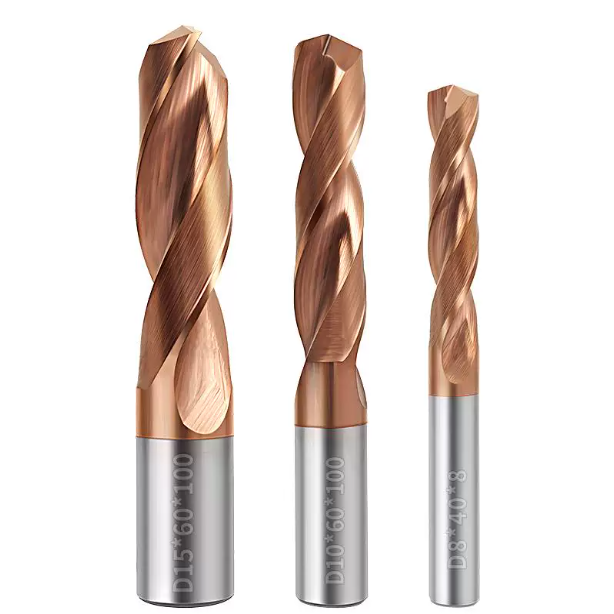
Post-Mortem on Machining Failures: Three Fatal Errors When Using Hard Steel Drill Bits
Whenever broken tools arrive at our lab from European or US shops, cross-sectional analysis tells a clear story. Over 80% of abnormal fractures stem from entrenched shop habits rather than tool material flaws. Drilling 60+ HRC D2 or A2 tool steel leaves zero room for error. We still see veteran shops applying medium-carbon steel drilling habits to fully hardened die blocks.
Hard steel machining is unforgiving; it tolerates no lateral impact or chip pinching. When core hardness challenges the substrate’s transverse rupture strength, a slight programming misstep creates destructive shear spikes. Unless shops address these blind spots, even top-tier hard steel drill bits will only result in broken carbide, costly EDM extractions, and wasted machine capacity.
Spot Drill Angle Mismatch: Why Blind Spotting Destroys Carbide Drill Bits for Hard Steel
During a tool audit at a North American die shop, we caught operators using standard 90° or 120° spot drills before running 140° carbide drills. In soft steel, this centers the cut; on hardened D2, it invites disaster. The 140° drill contacts the chamfer at its outer cutting corners first rather than its chisel edge. This puts extreme lateral tearing forces on the corners within milliseconds of entry.
When the outer corner takes the initial thrust, it shears off instantly, destroying the entire cutting lip. On flat surfaces with rigid setups, we advise omitting the spot drill entirely. High-rigidity geometries enter flat faces cleanly without wandering. If an angled face demands a pilot hole, use a spot drill with an angle equal to or greater than 140° to protect your carbide drill bits for hard steel.
Flawed Evacuation: The Impact of Full-Retract Pecking on HRC65 Carbide Drill Bits
Many programmers rely on full-retract cycles (like G83) as a safeguard against chip packing in deep holes. However, applying full retracts to hardened tool steels is fatal to carbide. Solid carbide needs steady axial load to dampen chatter in high-hardness cuts. Once the drill pulls completely out of the hole, loose chips wash down with the coolant and settle across the hole bottom.
When the spindle plunges back in at rapid feed, the cutting lips hammer directly into loose, hardened debris. This sudden dynamic shock shatters hrc65 carbide drill bits, which trade fracture toughness for extreme hot hardness. Instead of full retracts, we program micro-retract chip breakers (like G73 with 0.2mm to 0.5mm relief) or use 50+ bar through-coolant to flush chips out continuously without clearing the hole.
Spindle Load Alerts: Reading Load and Audio to Detect Drill Bit for Hard Steel Wear
Never wait for visible edge failure when drilling hardened tool steels. High-chromium alloys work-harden aggressively under friction. Once the flank wear land (VB) reaches just 0.08mm, the tool stops cutting and begins galling the hole wall. A healthy cut produces a steady, crisp hum; if the spindle tone shifts to a hollow roar or periodic squeal, the edge has already degraded.
Beyond audio cues, spindle load meters provide your best defense against broken tooling. Establish a baseline load reading on fresh tools once the drill reaches full engagement. If drive load climbs by 15% to 20% at that same depth, flag the tool immediately. Swapping out a worn drill bit for hard steel before it galls in the bore is the best way to safeguard expensive dies.
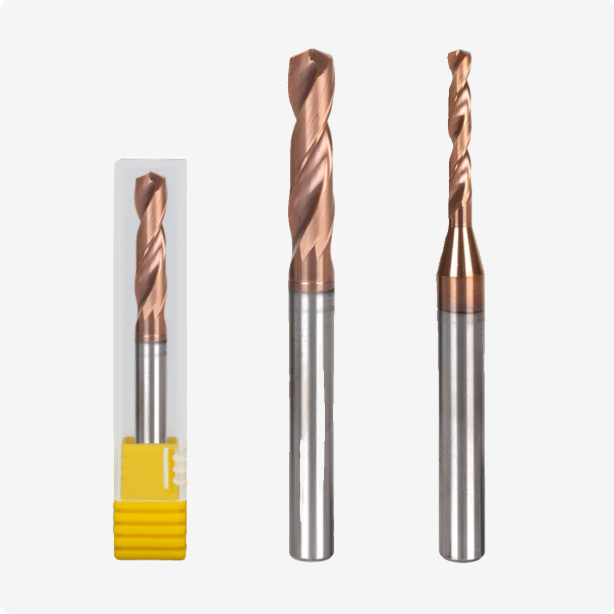
Inside the Manufacturing Process: How Carbide Drill Bit Manufacturers Ensure Consistency
To the naked eye, finished drill bits from the same batch look identical on the shelf. Put them to work on 60 HRC D2, however, and tool life can vary wildly from tool to tool. As carbide drill bit manufacturers working directly on toolroom floors, we know this spread rarely stems from five-axis grinding tolerances. It traces back to powder metallurgy, grain consistency, and coating adhesion control.
When cutting hardened die steels, internal voids, grain boundary clusters, and uneven coating stresses become failure points against abrasive carbides. Consistent tool life requires designing the carbide microstructure specifically for impact and wear. If tool life in your shop varies unpredictably across shifts, you need to examine the metallurgical standards behind your tooling supplier.
Rod Selection: Balancing Sub-Micron Grain Size and Cobalt Binder Content
Selecting carbide rod stock goes far beyond verifying nominal hardness. When engineering blanks for hardened D2 and A2 tooling, we focus on the hard-phase to binder-phase ratio. Experienced carbide drill bit manufacturers keep cobalt content tightly controlled between 8% and 10%, paired with an ultra-fine tungsten carbide (WC) grain size of 0.4 to 0.6 microns.
Excess cobalt lowers substrate hardness, causing the cutting edge to wash out against abrasive chromium inclusions. Too little cobalt leaves the core brittle, vulnerable to machine vibration and chatter. If you run deep-freeze treated A2 with inconsistent hardness, check your tooling’s fracture toughness (K1C) ratings to ensure the substrate resists abrasive wear while absorbing cut entry shock.
High-Heat Coatings: Why Our Hard Steel Drill Bits Feature AlTiN/TiSiN Formulations
D2 tool steel has poor thermal conductivity, forcing nearly all cutting heat back into the tool interface. Standard TiN and TiCN coatings oxidize and peel away within seconds under dry friction at 60 HRC. That is why we formulate our hard steel drill bits exclusively with silicon-doped, high-aluminum coatings like AlTiN and TiSiN to withstand extreme thermal exposure.
When cutting-zone temperatures pass 800°C, aluminum migrates to the surface, creating an amorphous aluminum oxide barrier. Silicon refines the nano-composite coating, raising oxidation resistance past 1100°C. If coolant cannot reach your cutting depth, evaluate your tool coating’s hot hardness to ensure it blocks chemical diffusion and workpiece welding under red-hot conditions.
Engineered Tooling: How Carbide Drill Bit Manufacturers Solve Deep and Stepped Holes
Standard off-the-shelf drills only cover clean, flat-bottomed through-holes. Real-world stamping dies, however, present counterbores, ejector pin steps, and cross-hole interruptions. Dedicated carbide drill bit manufacturers engineer targeted solutions for these features—optimizing web tapers, flute polish, and transition step radii to prevent harmonic chatter during interrupted cuts.
If you are dealing with high depth-to-diameter holes or angled entries in hardened tool steels, review your setup rigidity, coolant pressure, and part drawings with our team. Often, a slight change in margin clearance or chip-breaker radius turns an unpredictable bottleneck into a stable, lights-out machining process.