A couple of months ago, we hopped on an emergency remote call with an Ohio automotive stamping plant. A nearly finished D2 mold insert—heat-treated to a rock-solid HRC 60—was set up on a high-end 3-axis machining center. The operator grabbed a conventional cobalt drill bit, relying on old habits. Less than three seconds into the cut, the spindle let out a violent scream, snapping the main cutting edge right off at the hole bottom. The insert was nearly scrapped, threatening thousands of dollars per day in late delivery penalties.
We have seen this exact disaster play out dozens of times across North American and European toolrooms.
Once tool steel goes through final heat treatment, standard metal drill bits for hardened steel fail almost immediately. This happens on D2 loaded with abrasive carbides, H13 prone to thermal hardening, and high-impact S7 alike. Even veteran CNC programmers who excel at milling and wire EDM run into trouble here. They usually end up with severe work hardening from chisel-edge friction or total tool fractures from chip packing.
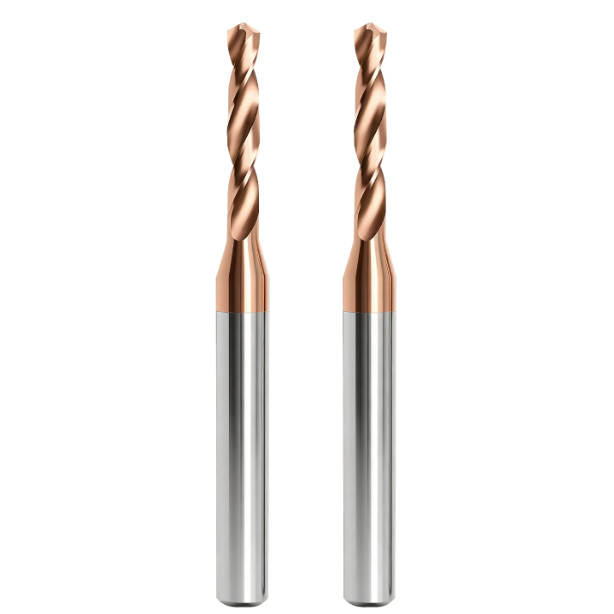
After fifteen years of building tools on 5-axis CNC grinders, we know success over HRC 50 leaves zero room for luck. So, what drill bit is best for hardened steel? It takes far more than grabbing a bit off the shelf with “hardened” printed on the box. You need the right substrate transverse rupture strength (TRS), sub-micron grain size, negative rake prep, and heat-resistant nanocomposite coatings. In our grinding shop, we manufacture carbide drill bits for hardened steel daily, dialing in the feeds directly on production machines to pinpoint the best drill bits to drill hardened steel.
Are you going to keep letting your operators rely on “feel,” gambling an expensive, finished die block on luck alone?

What Drill Bit Is Best for Hardened Steel in Mold & Die (HRC 48–62)?
If you run a mold shop, you know the drill: the block comes back from heat treat at a verified HRC 58, and an urgent change requires adding ejector pin holes. Operators often grab whatever carbide drill is sitting in the crib, only to watch the load monitor peg red within seconds. Finding what drill bit is best for hardened steel is not about catalog labels; it comes down to dynamic fracture toughness the moment the cutting edge bites into that case-hardened skin.
Most fatal failures we diagnose occur in the first two millimeters of cut. General-purpose carbide grades simply cannot handle the microstructural changes found in steel tempered between HRC 48 and 62. Tool selection is always a calculated trade-off between abrasive wear resistance and impact strength. Because no single drill conquers both high-chrome cold-work and high-toughness hot-work steels, matching the geometry to the specific alloy is mandatory.
Why Standard Metal Drill Bits for Hardened Steel Fail Instantly on Air-Hardened Tool Steels
Air-hardening steels like D2 and A2 pack aggressive, tightly clustered chromium carbides throughout their matrix. Their micro-hardness easily surpasses that of the surrounding steel, essentially acting like embedded grinding stones. When typical metal drill bits for hardened steel touch down, the dead center of the chisel edge cannot generate shearing velocity. Instead of cutting, it rubs, spiking contact temperatures past 700°C in an instant.
Machinists often tell us their drills glow red immediately, retracting with the tip transformed into a wiped-out, rounded slug. Standard coatings and general-purpose carbide lack the red hardness to survive this thermal shock, causing the margin to anneal immediately. As the edge dulls, thrust force spikes exponentially. The tool either friction-welds into the workpiece or snaps from excessive torsional load.
Identifying the Best Drill Bits to Drill Hardened Steel Based on Core Hardness and Toughness
When we troubleshoot holemaking for automotive die builders, we evaluate the steel chemistry before opening our tooling catalogs. Drilling through wear-resistant D2 (HRC 58–62) requires a completely different approach than cutting tough H13 or shock-resistant S7 (HRC 48–54). To determine the best drill bits to drill hardened steel, you must identify whether the core is brittle-hard or gummy; that mechanical behavior dictates the shear stresses hitting your cutting edge.
For wear-intensive cold-work steels, we utilize a reinforced negative rake and corner chamfers to crush through primary carbides. However, running that same geometry in H13 invites disaster. H13 retains substantial ductility, causing sticky chip flow and rapid built-up edge. If your flutes cannot evacuate those chips, the tool packs and binds. Match micro-negative hones to abrasive steels, and pair polished flutes with sharper edges for ductile, tough alloys.
The Critical Balance of Sub-Micron Grain Substrate and Cobalt Content in High-HRC Machining
On our CNC tool grinders, selecting rod stock for hard-milling drills is our most critical decision. Many programmers assume that higher workpiece hardness simply requires a harder, low-cobalt grade. But over a decade of floor testing proves that when building carbide drill bits for hardened steel, transverse rupture strength (TRS) matters more than nominal hardness. If the substrate is brittle, minute spindle vibration will instantly propagate micro-cracks across the cutting lip.
We rely on sub-micron tungsten carbide substrates (0.4 to 0.6 μm grain size) combined with an 8% to 10% cobalt binder for materials around HRC 60. The sub-micron structure packs grain boundaries tightly, halting micro-cracks before they spread. Meanwhile, the controlled cobalt matrix delivers the elastic cushion needed during the shock of initial entry. Sacrificing a fraction of theoretical hardness gives you predictable tool life and stops unexpected edge chipping.
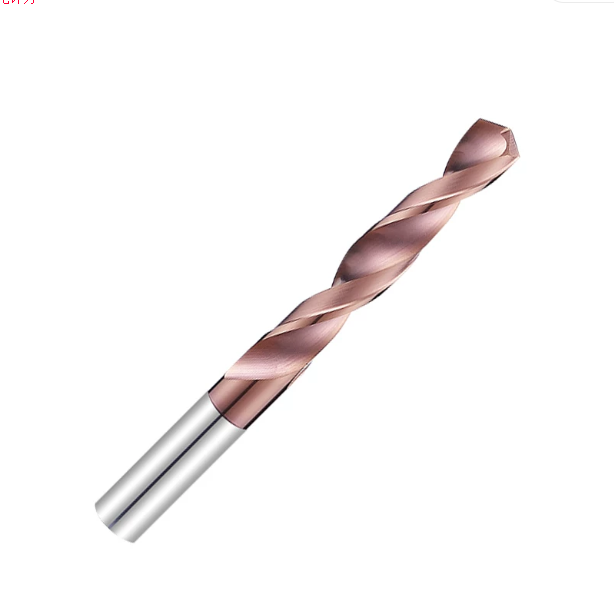
Engineering Carbide Drill Bits for Hardened Steel: Substrate, Geometry, and Coating Selection
Engaging a workpiece hardened past HRC 55 immediately tells you whether a tool is up to the task. Building a drill that survives this cut requires a balanced system of micro-grain substrate, edge geometry, and PVD coating. Many shops focus solely on surface speed, but when manufacturing specialized carbide drill bits for hardened steel, a slight miscalculation in core web thickness or margin clearance can spike tool failure rates tenfold.
In our grinding shop, years of deep-hole testing proved that extreme cutting forces punish any stress concentration along the lip. In high-hardness applications, geometric design must prioritize edge toughness over sheer sharpness, while coatings must deflect cutting heat. Balancing these elements creates a predictable wear pattern, helping your shop avoid catastrophic fracture inside expensive cavities.
Modifying Point Angles and Negative Chisel Edges on Drill Bits for Drilling Hardened Steel
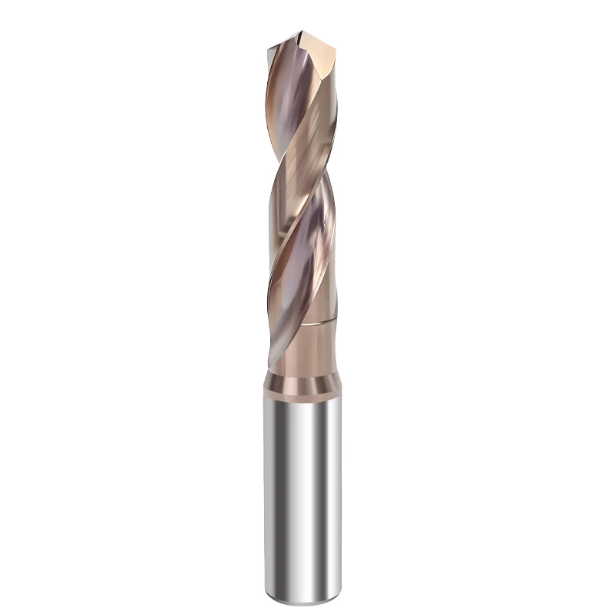
Initial contact generates severe plastic deformation right at the chisel edge. While a standard 118° point angle cuts soft carbon steel cleanly, it flexes and walks on hardened surfaces above HRC 50. To eliminate wandering and balance axial thrust, we grind dedicated drill bits for drilling hardened steel with a 140° or 142° point angle. Paired with heavy flank clearance, this geometry creates a rigid center that punches smoothly through the hardened case.
Web thinning makes or breaks the cut. We replace standard straight chisel edges with an S-shaped split point featuring a micro-negative rake. This converts pure frictional extrusion into clean shearing while reinforcing both corners against shock. While a negative hone slightly increases required machine thrust, the added safety margin against chipping easily outweighs the risky pursuit of a razor-sharp edge in abrasive tool steel.
Heat Dissipation and Red Hardness: Why AlTiN and AlCrN Are Essential for Drill Bits for Hardened Metal
Hardened tool steels dissipate heat poorly, leaving extreme thermal energy trapped at the drill tip. Our thermal imaging consistently records localized cut-zone spikes exceeding 900°C. Standard tools quickly discolor, their coatings flaking off like dry skin. Without extreme red hardness, even high-end solid carbide softens from thermal fatigue, leaving the tool defenseless against abrasive wear.
For severe high-load cuts, we avoid general-purpose TiN or TiCN, relying instead on nanocomposite AlTiN and AlCrN coatings when building drill bits for hardened metal. Under cutting friction, AlTiN forms a dense aluminum oxide layer that acts as a thermal shield. In abrasive tool steels, chromium-doped AlCrN provides superior adhesion and toughness. These coatings endure temperatures up to 1,100°C while their low friction coefficient slows heat migration into the carbide core.
Internal High-Pressure Coolant vs. Air Blast in Deep Hole Drilling for Hardened Mold Plates
Coolant strategy sparks endless debate on the shop floor. Operators often rely on external flood lines, but we strictly forbid this when drilling deep ejector pin holes in hardened stock. Chips packed in the flutes block fluid from reaching the cutting lips. The tool cycles violently between red-hot cutting and sudden splash quenching, causing rapid thermal shock fractures that crack solid carbide along the flutes.
For reliable deep-hole mold work, we insist on through-spindle coolant running at 70 bar or higher, or a high-flow vortex cold-air gun. High-pressure through-coolant blows past the vapor barrier, coating the cutting lips while blasting hard chips out of the hole. If your spindle lacks high-pressure coolant, sub-zero air clears chips cleanly. Dry air machining yields far better tool life than erratic, low-pressure wet flooding.

Material-Specific Machining Case Studies: Machining D2, H13, and S7 with Metal Drill Bits for Hardened Steel
Running cold-work stamping dies, aluminum die-cast blocks, and forging inserts requires distinct cutting setups. Supervisors often try running one standard tool across every job, only to watch it shatter the moment the steel grade changes. Applying metal drill bits for hardened steel is never a one-size-fits-all process. The underlying metallurgy dictates how the tool fails—whether through abrasive wear, adhesive galling, or sudden mechanical fracture.
Field support across North America and Europe has shown us that machinists instinctively drop feed rates when drills struggle, but that mistake quickly ruins the tool. Below, we break down our verified shop parameters for D2, H13, and S7 blocks. Each material demands specific tradeoffs between surface speed, positive chip load, and edge preparation.
Drilling Through Abrasive Carbides in D2 Cold-Work Tool Steel (HRC 58–62)
Cutting D2 at HRC 60 is like forcing a drill to strike micro-fine diamond abrasive wheels at high RPM. Once fully quenched, this high-carbon, high-chrome steel packs dense chromium carbides that grind edges flat. Running excessive surface footage overheats the carbide instantly. When setting up drill bits for drilling hardened steel in D2, our baseline rule is simple: run low cutting speeds to manage heat, and maintain a firm feed to punch through the hard case.
On D2 punch retainers, we lock surface speed to a conservative 20–30 m/min while holding feed between 0.03 and 0.06 mm/rev. Never let the spindle dwell in the cut. If your feed is too light, cutting thickness drops below the edge-hone radius, rubbing the workpiece glazed and spalling the flank. A positive, uninterrupted feed forces the edge beneath the work-hardened layer, giving you predictable hole counts per tool.
Tackling Thermal Fatigue and Core Toughness in H13 Hot-Work Die Steel (HRC 48–54)
Machining pre-hardened H13 shifts the failure mode from abrasive wear to red hardness and chip welding. Formulated with molybdenum and vanadium to withstand thermal fatigue in die casting, H13 retains exceptional core toughness at HRC 50. When cutting with general carbide drill bits for hardened steel, chips do not break into small flakes; they form tough, continuous ribbons that weld to flutes and seize the tool.
To stop chip packing in deep ejector pin holes, we grind a reinforced negative corner chamfer at the outer margins. This prevents hole-wall springback from pinching the drill while providing open flute clearance for chip evacuation. We recommend moderate surface speeds (35–45 m/min) paired with high-pressure coolant. With depth-to-diameter ratios past 5D, maintain rigid spindle engagement to prevent built-up edge from tearing the cutting lips.
High-Impact S7 Shock-Resisting Steel: Preventing Chipping and Work Hardening
S7 tool steel is engineered for extreme impact resistance in high-tonnage punch tooling, making it exceptionally tough to drill. Under heavy axial thrust, S7 deforms reluctantly, piling up along the chisel edge and driving torque monitors through the roof. When running standard metal drill bits for hardened steel, operators often hear a dull groan from the spindle seconds before the drill snaps in the hole.
To tame S7, our grinding shop focuses entirely on minimizing friction. Beyond selecting a high-impact sub-micron substrate, we run a 5-axis mirror-polishing pass along both helical flutes to remove all transverse wheel grinding marks. These slick flutes drop chip-evacuation torque by over 30%. Paired with a steady, single-pass feed cycle, this setup prevents work-hardening and shields cutting lips from chatter-induced chipping.
CNC Setup, Toolholding, and Parameter Protocols for Drill Bits for Hardened Metal
When reviewing snapped tooling with overseas shop managers, poor wear resistance is their usual complaint. Yet grabbing a dial indicator to sweep the spindle or inspecting the setup almost always exposes the real culprit. In steel above HRC 50, tooling represents only half the equation; the rest depends on toolholder rigidity, spindle health, and parameters. If there is runout upstream, even dedicated drill bits for hardened metal will shatter from microscopic chatter.
Hardened die steels create intense radial separation forces that quickly punish marginal workholding setups. Programmers often assume that merely dialing back RPM guarantees safety, but that ignores the physics of cutting high-hardness stock. Over fifteen years on the floor, we have treated rigidity as a non-negotiable rule. From rigid table clamping to minimal tool stickout, solid machine setups are mandatory to prevent chipping.
Toolholder Rigidity: Why ER Collets Ruin Carbide Drill Bits for Hardened Steel
If you are still chucking solid carbide drills into standard ER collet chucks for hardened jobs, stop the spindle immediately. An indicated runout (TIR) of 0.01 mm might pass in soft steels, but it ruins brittle carbide drill bits for hardened steel. A slight eccentric runout forces a single cutting lip to shoulder over 70% of the initial impact load, inducing rapid fatigue micro-chipping that snaps the tool within a few revolutions.
We enforce a strict 0.003 mm maximum TIR at the drill tip across our production partnerships. Achieving this standard requires switching to shrink-fit or precision hydraulic toolholders. Shrink-fit tooling delivers continuous 360-degree radial clamping with minimal overhang to combat tool deflection. Hydraulic holders provide uniform gripping force while damping harmful high-frequency cutting harmonics, cutting unexplained tool breakage in half.
Feed Rate and Speed Matrix: Real Shop Floor Feeds (No Theoretical Catalog Numbers)
Tool catalog feeds and speeds lean heavily toward theoretical maximums derived from pristine test benches. Blindly applying these numbers on worn machine guides or long-reach setups quickly breaks tooling. Identifying the best drill bits to drill hardened steel is only the first step; running predictable parts requires conservative, field-tested surface footage and feeds matched to tool diameter.
On vertical machining centers cutting HRC 55 tool steel, we run surface speeds (Vc) between 25 and 38 m/min. For 3 mm to 5 mm drills, set the spindle to 2,000–2,800 RPM with feeds (fn) of 0.02–0.035 mm/rev. For 8 mm to 12 mm holes, drop to 750–1,300 RPM while increasing feed to 0.05–0.09 mm/rev. Never drop feed rates out of hesitation; falling below the edge-hone radius causes rubbing and work hardening.
Peck Drilling Logic: Micro-Peck Cycles vs. Continuous Feed to Eliminate Chipping at Hole Bottom
Defaulting to standard G83 full-retract peck cycles in hardened steel remains a frequent cause of chipped edges. Retracting clear out of the hole allows abrasive work-hardened chips to drop straight into the blind cavity. When running high-performance metal drill bits for hardened steel, rapid-traversing back to depth slams the carbide tips directly into that debris, instantly fracturing the web and corners.
We program continuous feeds or controlled micro-peck cycles (G73) to eliminate hole-bottom impacts. For depths up to 3D with adequate coolant, use a single continuous pass to maintain a steady cutting stress field. Beyond 5D, limit retraction to a tight 0.2–0.5 mm—just enough to relieve cutting pressure and snap the chip. Keeping the drill tip engaged stops thermal shock and prevents catastrophic tool breakage.
Why Global Tooling Shops Partner with SAMHO Drill Bit Manufacturer for Hardened Steel Applications
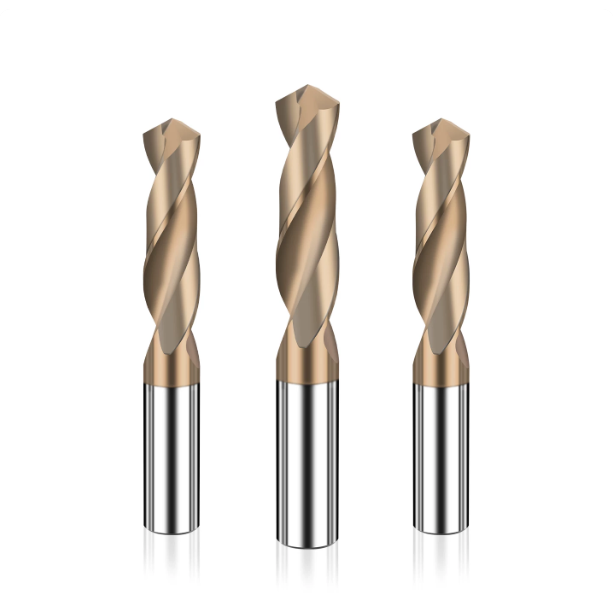
Experienced die builders understand why leading shops stop relying on standard catalog tools and work directly with factory engineers. When drilling inserts between HRC 50 and 62, a drill is not a cheap consumable—it protects the expensive machining hours already invested in the block. Benchmark tooling facilities partner with SAMHO drill bit manufacturer because our team controls the entire process chain, from rod metallurgy to 5-axis grinding.
Standard off-the-shelf tooling struggles against abrasive D2 carbides, gummy H13, and high-impact S7. We bridge the gap by connecting machine operators directly with our grinding engineers, feeding floor data back into our CAD/CAM grinding wheels daily. Working directly with our technical team takes the guesswork out of tool failure, turning difficult hard-steel holemaking into a dependable, repeatable routine.
Consistency in Tool Life: In-House 5-Axis CNC Grinding and Edge Preparation Quality Control
If three drills perform flawlessly but the fourth chips out within millimeters, your problem is inconsistent edge prep, not spindle dynamics. A micro-honing variance of just 5 microns between batches dramatically changes the friction and shear heat generated on contact. When grinding our high-performance carbide drill bits for hardened steel, we treat wheel dressing and automated brush honing as our most critical production operations.
Every drill passes high-magnification optical inspection to verify edge prep, hone radii, and corner chamfers. This tight tolerance band eliminates micro-notches that could propagate into cracks under heavy load. If you struggle with unpredictable tool life on unattended shifts, verify your supplier’s micro-honing tolerances. Uniform cutting edges are essential for reliable CNC tool-load monitoring.
Custom Tool Geometry and Application-Specific Solutions from SAMHO Drill Bit Manufacturer
Catalog tools cover everyday jobs, but deep 15D–30D ejector pin holes, deep counterbores, and high-alloy steels demand tailored geometries. Standard flutes frequently choke when chips fail to clear cramped cavities. Backed by dedicated production cells, engineers at SAMHO drill bit manufacturer work directly from your part prints to produce application-specific tools without supply chain delays.
We adjust flute helix angles, back taper, and internal coolant ports to match your spindle pressure and steel hardness. If you are struggling with high scrap rates or long lead times on custom drills, share your part prints and machine specs with us. Custom-tailored core thicknesses and specific edge hones consistently resolve troublesome deep-hole bottlenecks on hardened parts.
Lowering Total Cost-Per-Hole on High-Hardness Mold Bases
Evaluating tooling costs purely on the drill’s invoice price ignores the real expenses on the floor. Breaking a budget drill inside a finish-machined mold block ruins days of skilled EDM and hard-milling labor. Choosing specialized drill bits for drilling hardened steel functions as inexpensive insurance against scrap, eliminating the downtime and repair fees of retrieving broken carbide from a finished cavity.
Engineered carbide substrates and high-adhesion nano-coatings substantially increase total hole count per tool. This durability eliminates frequent tool touches, offset updates, and mid-batch drill swaps. When you factor in saved EDM extraction time and uninterrupted spindle hours, dedicated hard-steel drills consistently lower your true cost per hole across every run.
If you are dealing with tool wear or difficult chip clearing on a hardened die block, share your steel spec, hardness, and hole depths with us. Let’s look over your setup and identify a dependable drilling cycle.