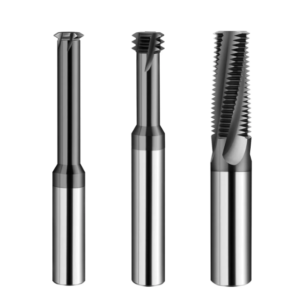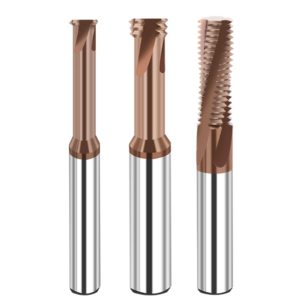
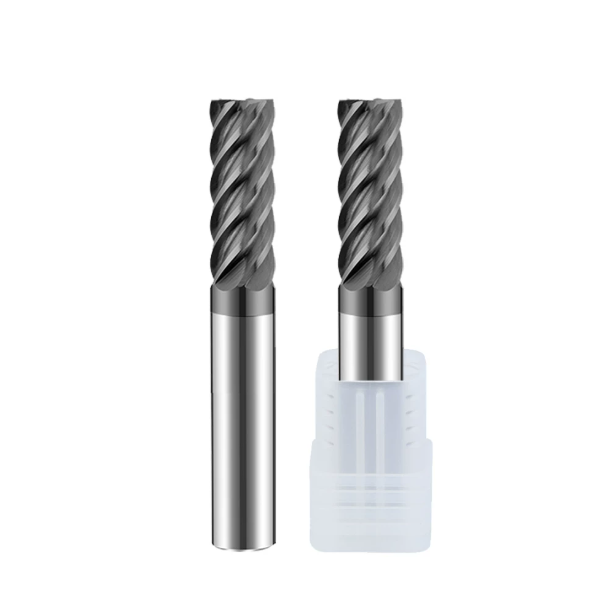
Earlier this year, while helping a German mold maker fine-tune HRC62 hardened D2 stamping dies, their chief programmer asked me directly: “We always use 4-flute end mills for everything. Why does switching to 6-flute cutters double tool life on some jobs, but chip or burn up on the very first slot on others?”
This is a daily reality in machine shops across North America and Europe. Over 15 years in tool manufacturing and field support, we see engineers struggle with this constantly. Most focus on coatings or brands, missing the core physical reality: the balance between flute count, cutting forces, and chip evacuation space.
Choosing between 4-flute and 6-flute carbide end mills for hardened steel comes down to balancing tool core rigidity against chip pocket volume. The wrong choice leads to chatter, rough surface finishes, or rapid heat buildup that ruins expensive hardened molds.
We base our advice on tens of thousands of real-world test cuts, 5-axis grinding experience, and hundreds of customer shop visits. Understanding how carbide end mills for hardened steel perform under different strategies will help you make more profitable tooling choices.
Have you ever lost hundreds of dollars on ruined cutters simply by picking the wrong flute count for steel over HRC60?
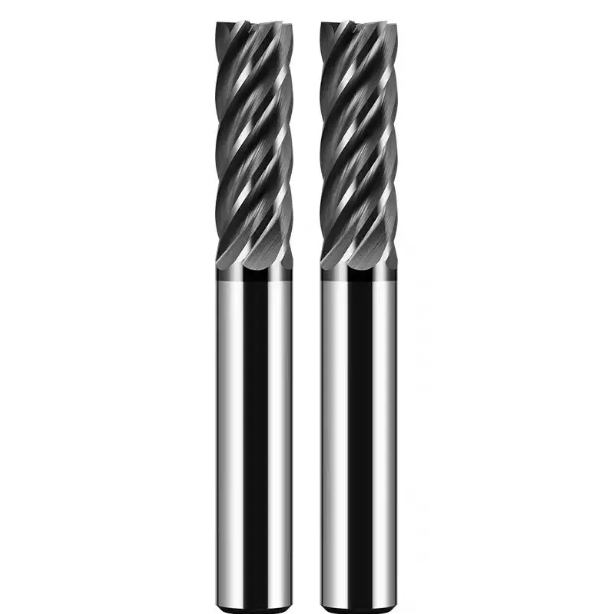
Key Performance Differences Between 4-Flute and 6-Flute Carbide End Mills for Hardened Steel
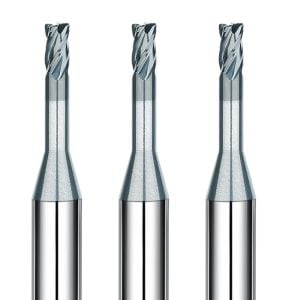
In our testing center, we run destructive limit tests using a high-rigidity HSK-A63 spindle. After recording over a decade of cutting data, the key physical difference comes down to this: 4-flute cutters provide wide chip evacuation channels, while 6-flute cutters deliver superior structural rigidity. Many operators either chase the high feed rates of 6-flute tools or stick to the safer 4-flute option. Both miss how core diameter dictates metal removal.
When grinding a 4-flute tool, we set the core diameter to about 60% to 65% of the total diameter, leaving deep chip gullets. On a 6-flute tool, we must increase the core to 70% or 75% to prevent tooth breakage. This thicker core greatly increases bending resistance against heavy lateral forces. However, it cuts the chip-carrying area nearly in half, which completely changes how the tool behaves in hardened steel.
Chip Gullet Space and Evacuation Efficiency: Real-World Performance of 4-Flute End Mills for Hardened Steel in Deep-Cavity Chip Evacuation
While troubleshooting H13 (HRC52–54) die sliders for an automotive customer, we pushed 4-flute end mills for hardened steel to their evacuation limit. When slotting at depths up to 1.5 times the cutter diameter, the deep gullets of the 4-flute design proved essential. Chips curled smoothly and evacuated without packing or re-cutting between the tool flutes and cavity walls.
However, test data also highlights the flexibility limit of a thinner core. When the tool overhang exceeds a 4:1 length-to-diameter ratio, 4-flute tools undergo micro-flexing under heavy cutting loads. Left unchecked, this flex triggers high-frequency chatter that leaves waves on the workpiece surface. In our shop, we prefer 4-flute tools for deep blind cavities, but we strictly limit the radial width of cut to control side loads.
Tool Rigidity and Feed per Revolution: Chatter-Resistance Advantages of 6-Flute Carbide HRC65 End Mills on High-Hardness Materials
When machining steels from HRC60 to HRC65 (like hardened SKD11 or S136), extreme material tensile strength causes cutting forces to spike. Under these conditions, 6-flute carbide HRC65 end mills excel due to their thick 75% core diameter. With more teeth engaged per revolution, cutting loads are distributed evenly across the cutter, smoothing out spindle torque spikes.
During test milling on HRC62 D2 steel blocks, a 6-flute cutter allowed us to boost the feed rate per minute by over 40% compared to a 4-flute tool at the same cutting speed (Vc = 120 m/min). Spindle vibration dropped noticeably, yielding straighter walls and finer finishes. Remember that 6-flute tools rely on a “light-cut, high-feed” strategy; taking an overly deep axial cut will instantly overload and chip the edges.
Cutting Heat Distribution: Measured Tip Temperature Rise and Annealing Risk for 4-Flute vs. 6-Flute Hard Milling End Mills
Friction heat is the primary failure mode when machining hardened metals. Using thermal imaging during dry milling, we monitored tip temperatures on both cutter styles. The tight flute spacing on 6-flute hard milling end mills traps heat easily, causing local tip temperatures to quickly top 800°C. Without continuous air blow, thermal shocks quickly crack the coating and soften the underlying carbide.
By contrast, 4-flute tools feature wider gaps that give each cutting edge a longer cooling interval between cuts. This time out of the cut allows heat to escape with the chip instead of soaking into the tool body. When setting up parameter libraries for clients, we mandate high-pressure air blasts with 6-flute tools and keep radial depth under 8% of the tool diameter. If air cooling is weak, switching back to 4-flute tools delivers far more predictable tool life.
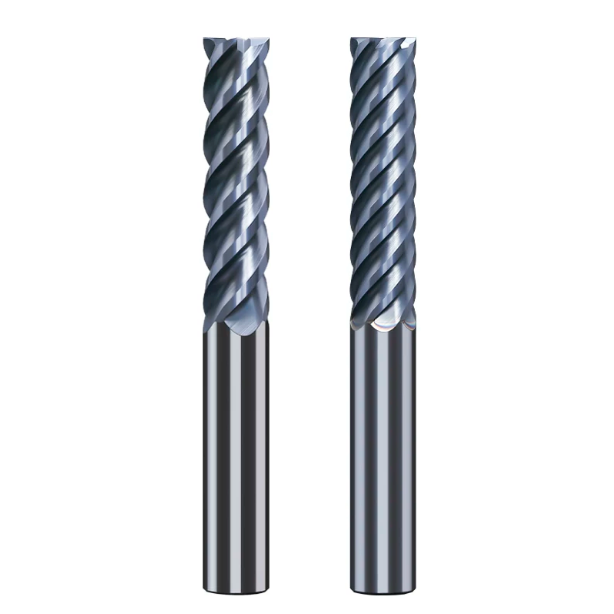
Optimal Use Cases and Troubleshooting for 4-Flute Carbide HRC65 End Mills in Hardened Steel Machining
A common pitfall in machine shops is trying to use one tool for every phase from roughing to finishing. As tool engineers, we know the physical boundaries of carbide HRC65 end mills. While 4-flute cutters are not a universal solution, they offer unmatched chip clearance and safety margins during heavy stock removal, interrupted cuts, and deep cavity roughing.
Field data shows over 70% of premature tool failures stem from a mismatch between geometry and application rather than material defects. The 4-flute design balances tooth strength with chip capacity, making it the primary choice for heavy-duty roughing in hardened steels. Mastering these applications is essential for preventing tool breakage and reducing per-part costs.
Why the 4-Flute Design is Essential for Roughing End Mills and Heavy-Duty Slot Milling
Full-slotting or heavy axial roughing in hardened steel generates massive volumes of fine, powdery chips. Using tools with six or more flutes leads to rapid clogging, chip re-cutting, and catastrophic tool breakage. Specially designed 4-flute roughing end mills feature wide helical chip gullets that provide an unobstructed path for rapid chip evacuation.
Heavy slot milling also generates severe radial cutting forces that require strong tool backing. The 4-flute configuration leaves ample carbide substrate behind each cutting edge to absorb cyclic impacts smoothly. In-house slotting tests on steel over HRC58 proved that 4-flute cutters maintain excellent stability without sudden edge chipping.
Vibration Damping and Chipping Prevention with 4-Flute HRC65 Corner Radius End Mills in Deep-Cavity Mold Roughing
Roughing deep cavity molds at length-to-diameter ratios above 5:1 is a major challenge in hard milling. We strongly recommend a 4-flute HRC65 corner radius end mill for these setups. Square end mills suffer from stress concentration at sharp tips, whereas a corner radius redistributes cutting forces across the arc, dramatically improving tip toughness against micro-vibrations.
A 4-flute corner radius tool also gives programmers greater flexibility when tuning parameters to eliminate chatter. High-frequency squeal at cavity bottoms can be resolved by reducing axial depth (Ap) and increasing feed per tooth (Fz) to direct forces axially up the spindle. This reduces lateral tool deflection and ensures safe corner clearance during long-reach machining.
A Typical Customer Case Study: Parameter Adjustments to Resolve Premature Wear in 4-Flute Carbide End Mills for Hardened Steel
A North American client reported that our 4-flute carbide end mills for hardened steel suffered severe flank wear within 15 minutes on HRC62 S136 steel. The customer suspected poor coating adhesion or a soft substrate. Upon auditing their CAM settings, we found the cutting speed was set too high (Vc = 150 m/min) during dry milling without air cooling.
Excessive speed in dry hard milling pushes cutting zone temperatures above 1,000°C, causing coating oxidation and substrate softening. We dropped the cutting speed to 90 m/min, increased feed per tooth from 0.03 mm/z to 0.05 mm/z to carry heat away in thicker chips, and added a 0.6 MPa cold air blast. Tool life immediately jumped to over 90 minutes with normal, uniform wear.
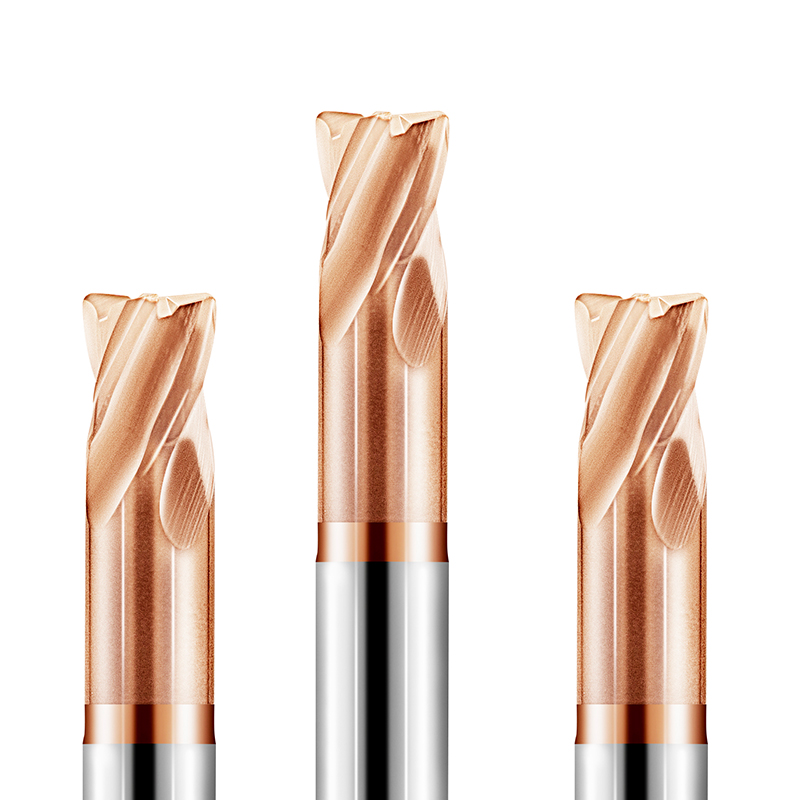
Ultra-Efficient Machining with 6-Flute Hard Milling End Mills: Achieving Ra 0.2 Mirror-Like Finishes
While 4-flute cutters handle heavy roughing, 6-flute hard milling end mills dominate precision finishing in hardened molds. Achieving a Ra 0.2µm finish directly on the CNC machine eliminates hand polishing that can destroy tight geometric tolerances. The key lies in leveraging the high cutting frequency and chatter-free stability of multi-flute tools.
Increasing flutes from four to six narrows the distance between feed marks and flattens cutting force spikes. With a thick core (70–75% of tool diameter), 6-flute tools show virtually no micro-deflection during light finishing passes. Assuming spindle runout is under 0.003 mm, a 6-flute tool is our top recommendation for final finishing on hardened steel.
Measured Surface Roughness Using a 6-Flute HRC65 Corner Radius End Mill for High-Hardness (HRC60–65) Finishing
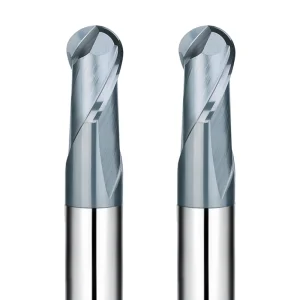
During optical mold testing on HRC62 S136 steel, we evaluated a 6-flute HRC65 corner radius end mill for mirror finishing. The corner radius prevents micro-chipping while producing a subtle burnishing effect on the workpiece. Using an axial depth of 0.08 mm and feed of 0.02 mm/z, we consistently achieved surface finishes between Ra 0.18µm and Ra 0.22µm, replacing EDM processes.
Achieving this finish depends heavily on flute height consistency and runout control. If individual flute heights vary by more than 0.002 mm, single-flute overloading occurs, leaving faint tool marks and causing uneven wear. We run every 6-flute tool through automated optical inspection so every edge cuts equally to guarantee consistent surface quality.
Leveraging High-Speed Milling (HSM) Strategies: Maximizing Feed Rates with 6-Flute Carbide HRC65 End Mills
High-Speed Milling (HSM) relies on light cuts, high spindle speeds, and aggressive table feeds, making 6-flute carbide HRC65 end mills ideal. With 50% more cutting edges per revolution than a 4-flute tool, table feed can be increased by 1.5 times without raising the workload per tooth. This slashes cycle times and flings cutting heat away in the ejected chips.
During extreme testing on HRC64 D2 tool steel at 12,000 RPM, we pushed feed rates past 2,400 mm/min using 6-flute cutters with smooth spindle load readings. However, pushing feeds this hard requires strong CNC look-ahead capabilities and fast acceleration controls; otherwise, feed lag in tight corners will overload the tool and cause edge chipping.
Preventing Chip Clogging: The Critical Radial Depth of Cut (Ae) Limit for 6-Flute End Mills for Hardened Steel
The main physical limitation of a 6-flute tool is its narrow chip gullet space, which causes chip packing and sudden breakage for inexperienced operators. When finishing hardened steel, fine chips rapidly pack the flutes if radial engagement is too high. Based on shop testing, radial depth of cut (Ae) for 6-flute end mills for hardened steel must be kept under 5% to 8% of the tool diameter.
As long as radial depth stays within this safe zone, high-pressure air blasts clear the ultra-thin chips instantly. If leftover material from previous roughing passes causes radial engagement to spike above 15%, a 6-flute tool will shatter immediately. Proper rest milling and corner clearing passes are mandatory before applying 6-flute cutters for high-efficiency finishing.
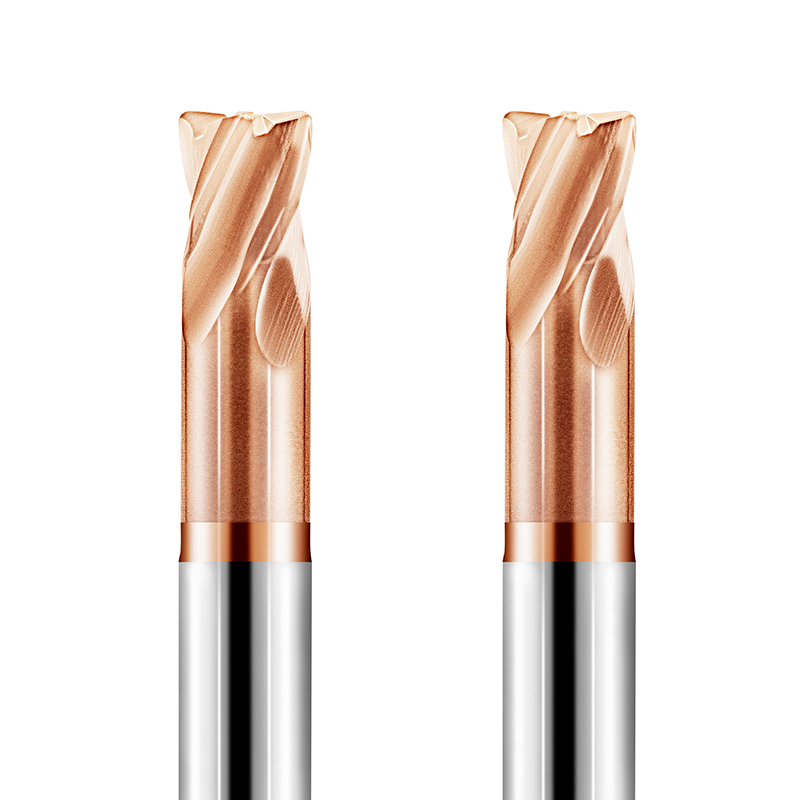
A Practical Selection Guide for Engineers: Decision Tree for 4-Flute vs. 6-Flute Carbide End Mills for Hardened Steel
Faced with a newly arrived hardened component at the machine setup station, choosing between 4-flute and 6-flute carbide end mills for hardened steel should never be guesswork. In our tooling management standards for European and American clients, every choice follows clear technical logic. Material hardness, machine spindle rigidity, and component geometry dictate how a cutter handles forces and heat in the cut.
Decades of field experience prove that optimal tooling decisions balance metal removal efficiency with process stability. To eliminate trial-and-error costs for programmers and shop-floor engineers, we developed a shop-tested selection workflow. Systematically breaking down physical machining conditions lets you choose the right flute count instantly, preventing unexpected tool breakage or lost productivity.
Selecting the Right Number of Flutes for Hard Milling End Mills Based on Material Hardness and Heat Treatment
Material hardness and microstructure serve as our primary guide for choosing flute count. When machining pre-hardened steels from HRC45 to HRC55 (like NAK80 or 718H), chips remain continuous and bulky. Here, a 4-flute hard milling end mills design provides ample chip clearance to prevent clogging, offering a balance of rigidity and depth-of-cut capacity for roughing and semi-finishing.
Once quenching pushes material hardness to HRC60–65 (like SKD11, D2, or S136), cutting mechanics shift radically: chips turn to fine powder and cutting forces spike. In this range, 6-flute cutters resist deflection thanks to their thick core. Running 4-flute cutters on steel above HRC60 invites tool flex and high-frequency chatter under heavy side loads, accelerating edge wear and shortening tool life.
Matching 4-Flute or 6-Flute Cutters Based on Spindle Rigidity and BT30/BT40/HSK Tool Holders
Tool performance depends heavily on the rigidity limits of the spindle taper and holder. On light BT30 drilling and tapping centers, limited pull-stud force makes side milling with 6-flute tools prone to high-frequency spindle resonance. For lighter setups, we recommend 4-flute cutters paired with shallow radial passes to reduce overall cutting loads and protect spindle bearings.
Conversely, high-rigidity machines using HSK-A63, HSK-E50, or dual-contact BT40 spindles easily handle heavy cutting resistance. These setups unlock the full geometric advantage of 6-flute carbide end mills for hardened steel. When paired with shrink-fit or hydraulic holders, 6-flute tools maintain ultra-low runout (< 0.003 mm) above 10,000 RPM, delivering fast, stable finishing passes.
Machining Thin-Walled and Deep-Cavity Parts: Reducing Cutting Forces and Deflection through Flute Count Selection
Machining delicate parts—like thin-walled housings or deep cavity dies—requires strict deflection control. Using a 4-flute hrc65 corner radius end mill converts part of the radial cutting force into axial downward force, reducing side pressure against flexible walls. Fewer teeth in the cut simultaneously lower total cutting load, making 4-flute tools ideal for long-reach deep cavities.
However, for ultra-light finishing on high-hardness thin walls, 6-flute cutters can also eliminate vibration. By keeping radial depth of cut (Ae) between 0.02 mm and 0.05 mm, the high cutting frequency performs a micro-shaving action with minimal force per tooth. This light engagement suppresses wall chatter, allowing engineers to pick the ideal tool based on wall stiffness and cut depth.
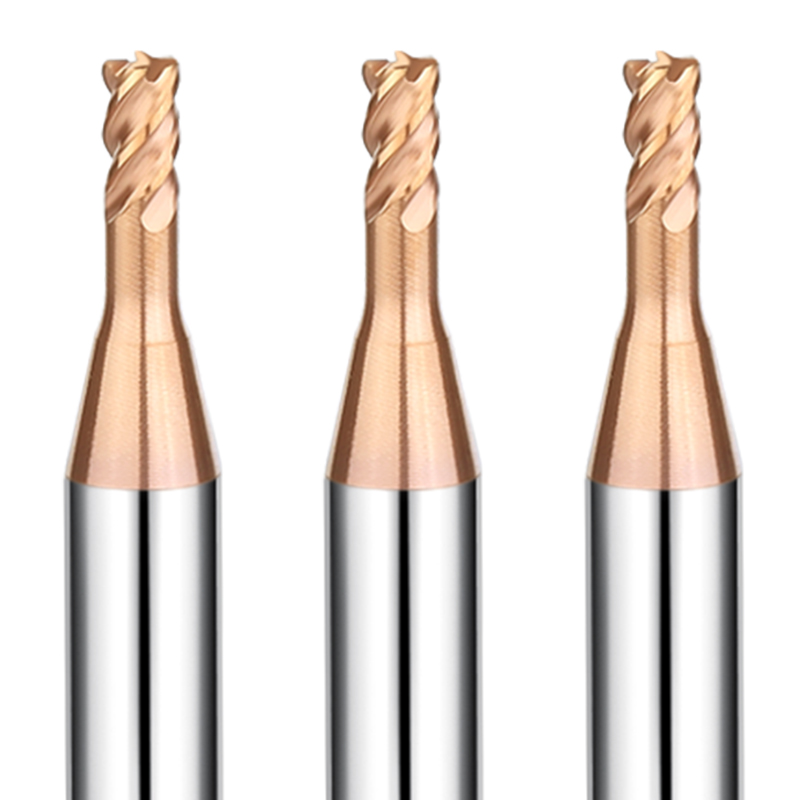
How to Assess the True Manufacturing Capabilities of Hard Milling End Mill Suppliers
During years of technical support for Western machine shops, we have seen buyers order tools based on glossy brochures, only to suffer frequent shop-floor breakages. For high-hardness machining, marketing claims are meaningless—true capability shows in manufacturing detail. Qualified hard milling end mills suppliers must enforce strict quality controls from raw bar stock to final coating checks.
Evaluating a supplier requires looking past the number of grinding machines on their floor to see if their process guarantees batch consistency. Minor tolerance fluctuations in a 4-flute rougher or 6-flute finisher are magnified when cutting hardened steel. If you are auditing new tooling vendors, assess their technical expertise across three core manufacturing dimensions.
Raw Material Control—Assessing Suppliers via Carbide Rod Grain Size (Micro-grain)
Carbide substrate quality dictates transverse rupture strength (TRS) and hardness limits. Reputable hard milling end mills suppliers never compromise on raw materials, using ultra-micro-grain carbide rods (0.2 µm to 0.4 µm) for tools targeting HRC60+ steel. Standard sub-micron rods contain coarser grains that act as stress points for crack propagation during interrupted cuts, causing rapid chipping.
If you machine molds with uneven hardness or cast scale, ask your vendor for exact cobalt content (Co%) and TRS ratings. Premium hard-milling carbide rods maintain high hardness alongside a transverse rupture strength above 4000 MPa. Every incoming batch should undergo random metallurgical checks to ensure the dense matrix needed to withstand high-speed cutting stress.
5-Axis Grinding and Micro-Edge Preparation: How Professional Hard Milling End Mill Suppliers Ensure Consistency in 4-Flute and 6-Flute Tools
Grinding carbide rods to shape is simple; keeping thousands of tools identical is the real challenge. Professional hard milling end mills suppliers use premium 5-axis grinders (like ROLLOMATIC or ANCA) with controlled edge passivation. Overly sharp edges chip instantly in HRC65 steel, whereas oversized edge hones create excessive friction, cutting pressure, and heat.
For mirror-finish milling, ask your supplier for tooth-to-tooth runout and edge hone inspection reports. In our grinding shop, 4-flute and 6-flute tools undergo in-process optical compensation to hold radial runout under 0.003 mm, alongside micro-passivation matched to target materials. Equal load across every cutting tooth ensures predictable feed rates and long tool life.
Coating Adhesion and Batch Stability: Evaluating the On-Site Testing Processes of Hard Milling End Mill Suppliers
Coatings serve as the first line of defense against high-temperature thermal oxidation. Dependable hard milling end mills suppliers never simply outsource coating and ship products without verification; they test every batch for adhesion and thickness. Hard-milling tools require Si-based or AlTiN/nACo nanocomposite coatings with HF1 adhesion ratings and strict 2 µm to 4 µm thickness control.
The most reliable way to evaluate a tool manufacturer is through standardized shop-floor testing. If you face edge chipping during cavity roughing, fail to hit surface roughness specs, or want to push your 4-flute and 6-flute feed rates further, share your operating conditions, drawings, and material specs with us. We can help tailor the optimal tool geometry and parameter strategy for your shop.