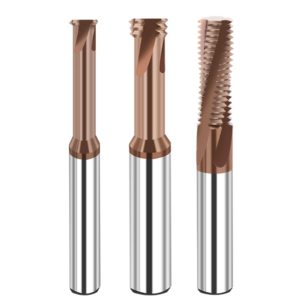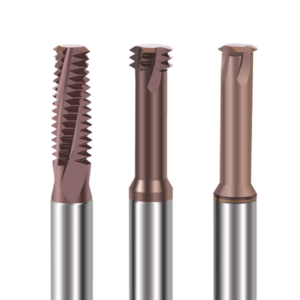
Last month, a German client specializing in precision automotive stamping molds sent an urgent request for help. While using a high-speed machining center to cut cavities in pre-hardened P20 mold steel, they were stuck with a surface roughness (Ra) exceeding 1.6 µm at the base of the 3D contours. Furthermore, tool life was extremely inconsistent; visible micro-chipping appeared on the ball-nose cutting edge after machining just two mold units.
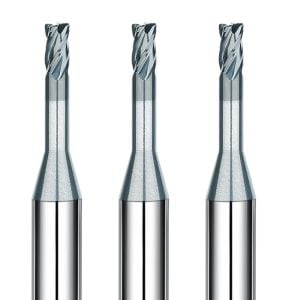
Upon reviewing their program, we spotted the root cause immediately: to beat a deadline, they had run a 2-flute ball nose end mill—meant strictly for semi-finishing corner clean-up—across the entire finish pass. While the table feed was high, the ball center had already flaked off from cyclical impact fatigue. We replaced it with our dedicated high-rigidity 4-flute carbide ball nose end mill and dialed in the chip load per tooth (fz). The result was a doubled feed speed and a surface waviness drop to a mirror finish below Ra 0.4 µm.
We have seen this exact scenario play out across European and American machine shops for over a decade. Whether you cut medium-carbon alloys, S136 stainless mold steel, or hardened tool steels up to HRC55, complex 3D profiling always brings up the same question: should you load a 2-flute vs 4-flute ball nose end mill into the spindle?
From our seat as a cutting tool manufacturer, this is never as simple as asking whether two extra flutes double your feed rate. When cutting steel, every added flute increases the cross-sectional core inertia for superior bending rigidity, but it severely steals gullet volume needed for chip evacuation. Conversely, fewer flutes evacuate chips reliably, but lower beam strength can cause deflection and leave unacceptable witness marks.
As machining peers who work daily with carbide substrates, edge preps, and micro-inch runouts, haven’t you also hesitated between chip clearance and tool deflection when setting up a steel profiling job?
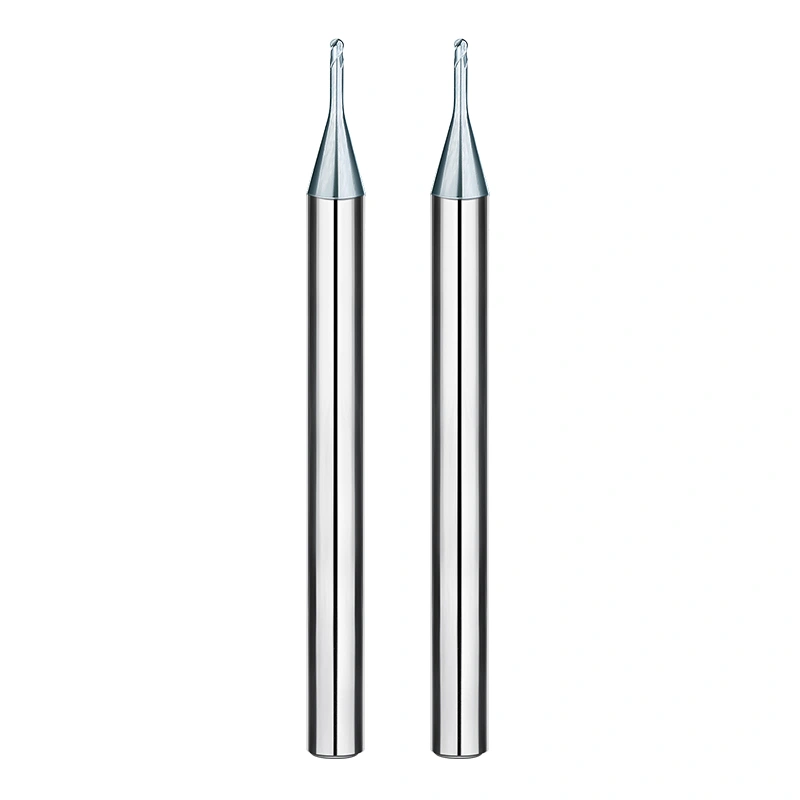
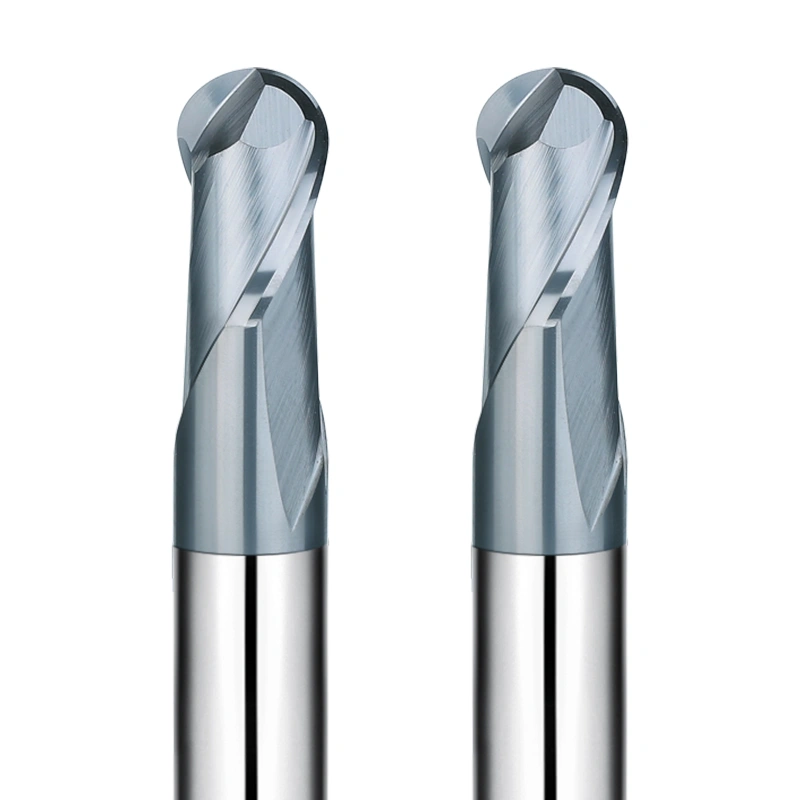
Shop-Floor Selection Pitfalls: Why Do Engineers Often Make Mistakes Regarding Flute Count When Selecting Ball Nose End Mills for Steel?
When machinists call us to troubleshoot premature edge failure, they usually blame poor coating adhesion or weak spindle rigidity. Yet seven out of ten times, the true culprit is a mismatch in flute count for the specific cut. Machining steel is not like cutting aluminum; high shear strain generates heavy heat and rapid work hardening. If your chip gullet cannot clear chips as fast as they form, the entire cutting zone breaks down instantly.
Most mistakes happen when programmers apply square-end mill intuition directly to a ball nose milling cutter for cutting steel. On a spherical ball profile, the effective cutting speed drops to near zero at the center line. This means picking your flute count is never just a feed calculation. It is an active mechanical trade-off between chip evacuation volume and tool deflection resistance under radial cutting pressure.
Field Feedback from Western Clients: The Real Root Causes of Chipping During Deep-Cavity Roughing and Witness Marks During 3D Surface Finishing
A North American gearbox manufacturer contacted us regarding a recurring crisis with their solid carbide ball nose cnc milling cutter line. While semi-roughing deep pocket cavities, their tools were snapping clean off at the flute root. The programmer had selected a 4-flute cutter to push feed rates, ignoring the confined deep slot where coolant could not flush chips. Red-hot chips packed the narrow gullets, spiked the spindle load, and shattered the tool.
Conversely, a European medical mold shop took the opposite extreme on mirror-finish contoured cavities. They ran a 2-flute cutter from roughing all the way to final pass. Chip evacuation was smooth, but achieving the required scallop height forced an impossibly small step-over that doubled machine cycle times. Worse yet, tool deflection on long overhangs generated chatter, leaving visible ripples that required hours of manual bench polishing.
The Fundamental Difference Between 2-Flute and 4-Flute Ball Nose Milling Cutters: The Physical Trade-off Between Core Rigidity and Chip Gullet Volume
On our 5-axis tool grinders, the geometry trade-off in a 2-flute vs 4-flute ball nose milling cutter is defined by the wheel pack. Grinding a 2-flute tool yields deep flutes and generous chip pockets, but the core diameter rarely exceeds 50% of nominal shank size. This open design swallows long, curling steel chips without packing, yet it gives up cross-sectional moment of inertia, making the tool flex easily under heavy side loads.
When grinding a 4-flute cutter, packing four flutes onto the same blank forces a shallower flute depth, raising the core web to 60%–70% of diameter. This thicker web yields exponential gains in bending stiffness, virtually wiping out deflection marks and chatter during high-speed finishing passes. However, the smaller gullets cannot handle bulky roughing chips. In steel machining, you must decide upfront: do you need pock
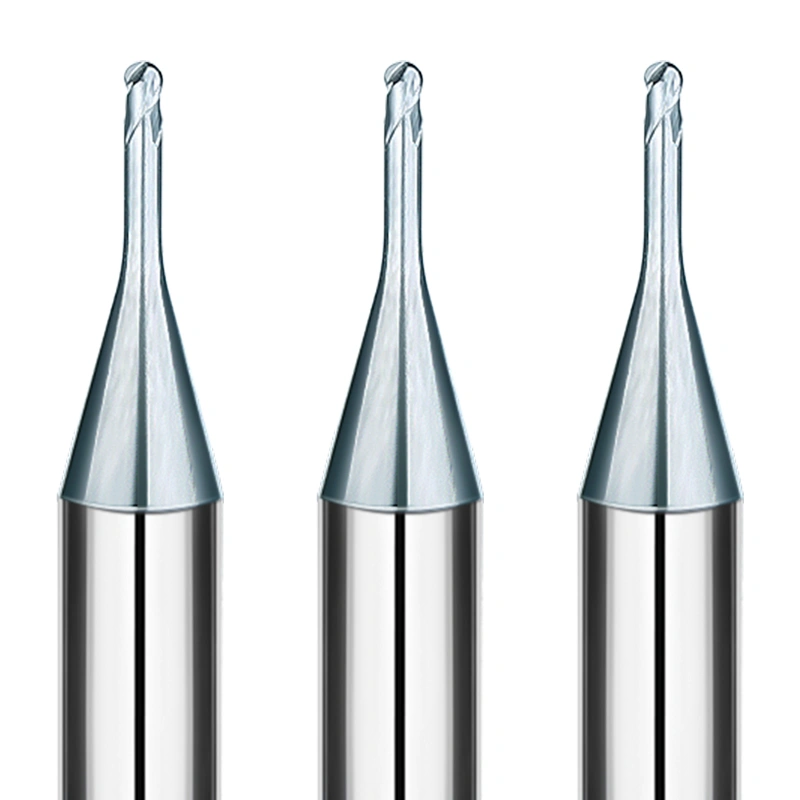
Operational Limits and Performance of 2-Flute Carbide Ball Nose End Mills in Steel Machining
In daily technical support, many machinists dismiss 2-flute cutters as too soft for cutting steel. However, in complex 3D pockets and deep cavities, the 2-flute carbide ball nose end mill holds an irreplaceable position. Its real strength is not flat-out metal removal rates, but bulletproof chip evacuation in deep, semi-enclosed cavities where heat and chips easily pack together.
Still, this design has firm physical limits. Because the core web is relatively small, taking overhangs past 4xD invites elastic tool deflection under heavy lateral loads. In our shop trials, we never spec a 2-flute tool for shallow, mirror-finish contouring passes. Instead, we treat it as an insurance policy against catastrophic edge chipping when pocketing gummy or stringy steel.
Advantages of 2-Flute Ball Nose CNC End Mills in Deep Cavities and Wet Machining
Last year, we helped a UK mold shop cut an automotive grille mold out of sticky, pre-hardened S136 stainless steel. They ran a multi-flute cutter for semi-finish corner clearing, but chips packed the narrow slot despite high-pressure coolant. The trapped chips recut and work-hardened, tearing up sidewalls and breaking the tool tip. We swapped in a 2-flute ball nose cnc end mill with mirror-polished flutes, and the problem vanished immediately.
The wide flute valleys and high helix angle let long, ribbon-like chips curl freely and flush out. With steady coolant flow, chips evacuate smoothly along the rake face without packing the bottom of the slot. When roughing deep pockets or clearing heavy corners, giving up a bit of table feed for reliable chip flow cuts your scrap rate and saves money overall.
The Zero-Velocity Dead-Center Trap: Guiding Machining Engineers to Adjust Plunge Strategies
When a ball nose milling cutter breaks repeatedly at the dead center, the carbide grade is rarely the culprit. You are fighting the basic geometry of a spherical tool tip. In 3-axis toolpaths, the surface footage drops to literal zero right at the tool’s rotational centerline. Because the tool cannot shear steel at zero SFM, plunging straight down along the Z-axis rubs and tears the metal until extreme compressive stress snaps the tip.
Whenever we review programs for our clients, the first thing we ban is straight vertical ramping. We set CAM routines to a 2° to 5° shallow helical ramp, or a smooth continuous trochoidal entry. By forcing radial motion during the plunge, the outer flutes with real cutting speed take the impact, bypassing the zero-speed dead center entirely. This single programming change saves more carbide than any other adjustment.
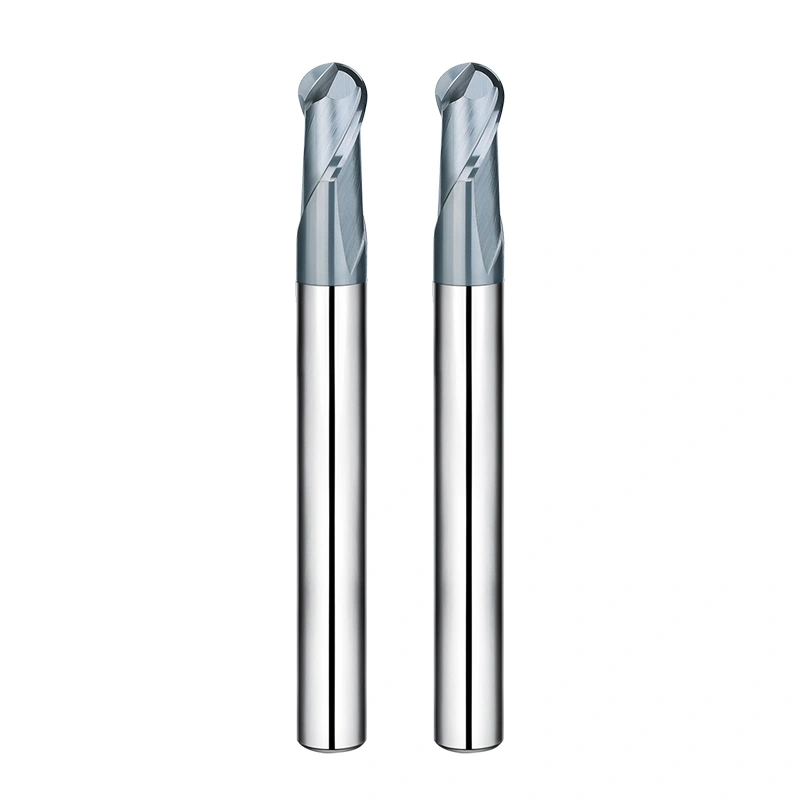
Practical Application of 4-Flute Carbide Ball Nose End Mills for Hardened Steel and Mirror-Finish Machining
Once you finish semi-roughing and move to the final profile pass, your main priority shifts from chip clearance to structural rigidity. For pre-hardened tool steels and quenched alloys, a 4-flute carbide ball nose end mill is our standard recommendation. Because finishing chip loads are light and produce powdery dust, the smaller flute gullets are no longer a handicap, while the massive core mass becomes a massive advantage.
Keep in mind that running a 4-flute cutter successfully requires minimal spindle and toolholder runout. If total indicated runout (TIR) exceeds 0.0001″ (3 µm), the flutes load unevenly in micro-depth cuts, turning steady chip loads into destructive single-tooth impacts. That runout ruins your surface finish and chips individual flutes early. Switching to 4 flutes means your entire setup must match that standard of rigidity.
Rigidity Performance of 4-Flute Ball Nose End Mills in High-Hardness (HRC55) Applications
A North American mold shop once asked us to fix persistent chatter marks on deep ribs in P20 and 718H bumper molds. They had been using 2-flute long-reach tools past 5xD, and tool deflection produced screaming chatter along the sidewalls. We moved them to a heavy-core tool tailored as an hrc55 ball nose milling cutter. The heavier cross-section doubled the tool’s bending resistance, killing the deflection and chatter instantly.
When cutting pre-hardened 40Cr or tougher alloys, tool deflection ruins surface accuracy in a heartbeat. The stout core of a 4-flute design handles high radial tool pressure with virtually zero deflection, even on longer reaches. You must program uniform stepovers because a stiff tool will not tolerate leftover stock in corners; keep the stock allowance clean, and the vibration dampening outperforms any 2-flute tool on the market.
3D Contour Finishing for Molds: Doubling Feed Rates and Controlling Surface Scallop Height
Our shop trials on 5-axis high-speed machining centers prove how much time a 4-flute design cuts from 3D finishing passes. While dialing in cycle times for a Swiss watch mold maker, the customer needed mirror surfaces with scallop heights under 1 µm. Switching from 2 flutes to a dedicated 4-flute ball nose milling cutter at the same feed-per-tooth doubled their table feed (Ft), cutting overall cycle time from 6 hours down to 3.5 hours.
On shallow mold cavities and tight contoured runners, surface finish comes down to stepover and tooth engagement. Four flutes yield tighter, denser cusps per inch, which wipes out visible toolpath witness lines when paired with a slight 5-axis tilt. The CAM program requires more calculation and tighter machine look-ahead, but it consistently delivers an Ra 0.2 finish that eliminates hours of hand benching.
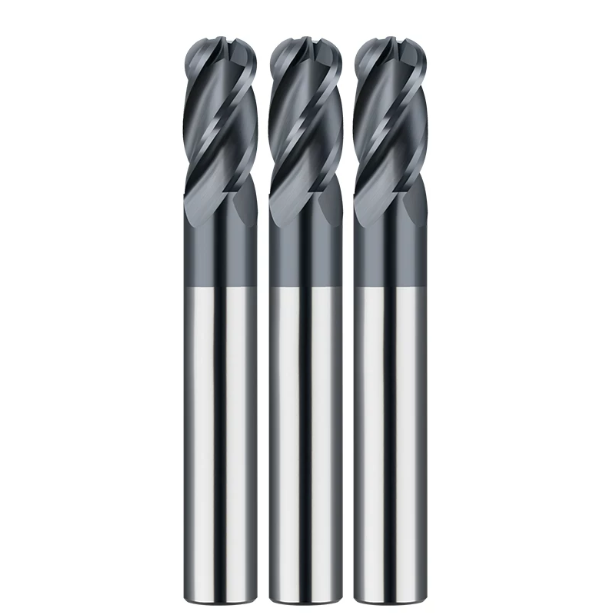
A Ball Nose Milling Cutter Manufacturer’s Perspective: Matching Micro-Geometry and Coatings to 2-Flute vs. 4-Flute Designs
On the shop floor, operators frequently blame chatter and edge chipping on feeds and speeds. However, as an experienced ball nose milling cutter manufacturer, we know these failures often trace back to wheel-pack setup on the 5-axis CNC grinder or targets in the PVD coater. Toolmakers must apply completely different micro-geometry logics when engineering 2-flute versus 4-flute milling cutters for steel.
Selecting flute count is never as simple as grinding two extra helical flutes into a carbide blank. A 2-flute cutter endures heavy chip loads and interrupted cutting, demanding high fracture toughness and impact resistance. A 4-flute tool takes light chip loads, where managing friction and maintaining keen edge sharpness matter most. Tweaking micro-geometry during grinding directly dictates tool life and part finish on your spindle.
Differences in Edge Honing for Steel-Cutting Tools: Impact Resistance for Roughing vs. Free-Cutting for Finishing
When prepping the edge on a ball milling cutter for cutting steel, we apply distinct micro-hones on our 5-axis grinders. For 2-flute cutters handling heavy semi-roughing, cutting edges face severe mechanical shock during initial engagement. We engineer a 10 to 15 µm symmetrical hone or a slight negative T-land. This reinforced edge dampens shock and prevents chipping against hard inclusions in structural alloys.
Applying that heavy hone to 4-flute finishing tools spells disaster. High-speed finishing drops chip load down to 0.0008″ (0.02 mm) or less per tooth. A large radius will plow and rub rather than shear, sparking work hardening and extreme thermal spikes. We keep 4-flute edge hones to an ultra-sharp 3 to 6 µm, preventing workpiece rubbing and eliminating microscopic witness marks.
Selecting AlTiN vs. TiSiN Coatings: Matching 2-Flute Heat Evacuation with 4-Flute High-Speed Wear Resistance
Substrate-coating adhesion targets also differ between flute counts. In high-stock steel semi-roughing, 2-flute tools benefit from deep, wide flutes that evacuate hot chips quickly. Here, we prioritize an AlTiN coating for its high adhesion and mechanical toughness. Its stable aluminum oxide barrier resists cyclical mechanical shock and blocks thermal stress cracks in wet or MQL environments.
For high-speed contour finishing on hardened steel with a carbide ball nose milling cutter, cutting temperatures frequently exceed 900°C. For 4-flute finishing tools, we use silicon-doped TiSiN nanocomposite coatings. While slightly less ductile than AlTiN, TiSiN maintains hot hardness up to 1,100°C. It forms an ultra-hard, self-lubricating shield that prevents thermal softening and protects edge geometry.
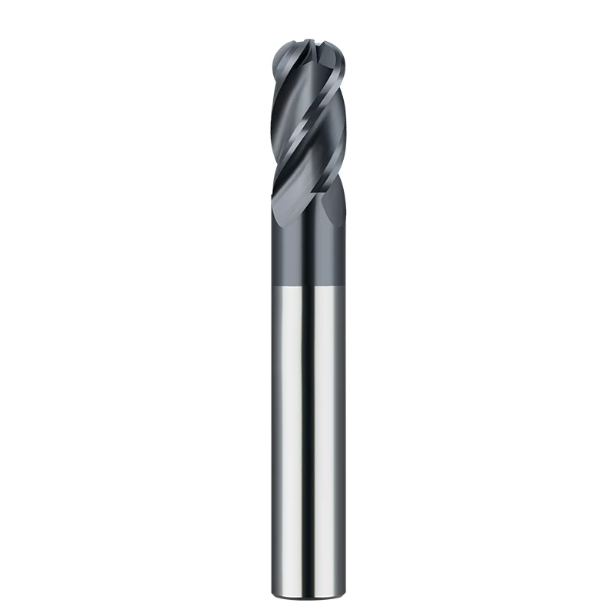
On-Site Process Decision Checklist: Quick Selection Guide for 2-Flute vs. 4-Flute Ball Nose End Mills
Setting up your machine tool requires balancing chip clearance against structural stiffness. No generic formula covers every job, but you can identify your primary process bottleneck quickly. You must determine whether your operation is limited by chip evacuation, tool deflection, or tight surface profile tolerances.
Avoid using a single tool from roughing through final finish passes. That habit drives up tooling spend and tanks spindle utilization. Maximize tool life by separating the open chip-pocket needs of semi-roughing from the rigid core requirements of high-speed finishing. Reviewing your operation through this mechanical lens will clear up your tool-selection process.
H3: Process Breakdown for Mold Steels (P20 / NAK80 / S136): Optimal Flute Combinations
Pre-hardened tool steels (P20, 718H) and gummy mold steels (NAK80, S136) place very different stresses on cutting flutes. Semi-roughing generates heavy, hot chips that cause micro-chipping if trapped. In contrast, final 3D contouring removes minimal stock, demanding exceptional core beam strength to maintain true spherical profile accuracy.
If you run high-stock semi-roughing or clean out steep corners, choose a 2 flutes ball nose milling cutter. Its generous flute valleys flush out stringy chips without packing, eliminating catastrophic breakage from recutting. If you run final surface contouring, step up to a stiff 4-flute cutter; its high core mass lets you double table feed rates while controlling scallop height.
H3: Choosing the Number of Flutes for Excessive Overhang (L/D) and Thin-Wall Machining
Deep mold cavities with long overhangs (4xD to 6xD) magnify cutting force fluctuations at the ball nose. When tackling deep reaches, deciding between heavy 4-flute core mass and lower 2-flute cutting forces comes down to radial engagement and workpiece rigidity.
If you finish deep floors with light radial stepovers and tight spindle runout, run an HRC55 ball nose milling cutter with 4 flutes. The large cross-sectional core stops tool deflection and kills squealing chatter on deep sidewalls. If you cut thin-walled pockets with poor part support, switch to 2 flutes; lower radial tool pressure prevents workpiece deflection and chatter.
Chipping edges and sidewall chatter simply indicate that tool geometry and cutting parameters are out of sync. If you are struggling with a tricky deep pocket or an unforgiving tool steel, feel free to share your part prints, stock allowances, and current feeds. Reviewing chip formation and load vectors together is usually the fastest way to dial in your setup.