A few months ago, a long-standing client—an aerospace component manufacturer in California—contacted our technical department with an urgent issue.
They had accepted a rush order for Ti-6Al-4V (TC4) structural parts, but deep-slot milling operations were causing severe spindle vibration. The machine kept triggering alarms, surfaces were marred by glaring chatter marks, and their imported cutting tools suffered catastrophic chipping in just 15 minutes. Lowering cutting speeds and switching to thicker tool holders only extended cycle times without solving the underlying problem.
This scenario was all too familiar to us. As a tool manufacturer with over a decade of shop-floor experience, we have encountered this exact challenge repeatedly at European and American facilities.
Titanium alloys have a low modulus of elasticity and extremely poor thermal conductivity; machining them through brute force leaves tools battered by work hardening and intense cutting resistance. In this high-stress environment, even premium solid carbide end mills cannot withstand the fatigue-induced edge chipping caused by violent harmonic resonance.
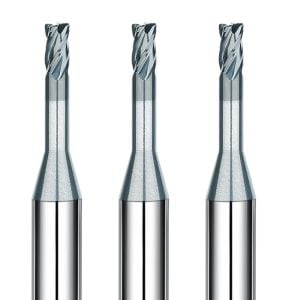
We sent the client our specialized CNC end mills for titanium—5-flute cutters featuring a variable helix angle and unequal tooth pitch.
The principle is straightforward: unequal tooth pitch breaks the rhythmic cycle of cutting forces, while the variable helix dynamically distributes forces along the Z-axis, cutting off vibration accumulation at the source. To eliminate tool bounce in deep cavities, we applied this vibration-damping geometry to long neck end mills and ball nose end mill for titanium designs. The test results met all expectations: chatter vanished instantly, surface roughness dropped from Ra 1.6μm to Ra 0.4μm, and tool life tripled.
The facts prove that when machining titanium alloys, it is far better to let optimized tool geometry shoulder the stress rather than forcing the machine tool to absorb it.
As end mill manufacturers who spend our days working on grinding machines and shop floors, we understand the strict requirements for supply chain stability and ROI. That is why more overseas machine shops are sourcing from a reliable china carbide end mill supplier with in-house R&D—because a truly great tool reliably produces qualified parts while driving down your cost per edge.
Is there a machine tool in your workshop right now running below capacity due to titanium chatter?
Why conventional tools inevitably chatter during titanium alloy machining
Having spent over 16 years on shop floors, we know that nine out of ten engineers seeking technical help with titanium milling are battling chatter. Most machinists initially blame weak machine rigidity or insufficient coolant flow. However, if you zoom in on the cutting zone, conventional tools reveal inherent geometric flaws when cutting Ti-6Al-4V. When flute spacing is uniform, cutting forces impact the workpiece at a fixed frequency, instantly triggering intense vibration in high-resistance titanium.
In most titanium milling applications, standard solid carbide end mills fail because their symmetric geometry cannot handle the material’s elastic recovery. Titanium’s elastic modulus is only half that of steel, causing the machined surface to spring back and rub fiercely against the flank face. If radial forces aren’t dynamically dissipated, these periodic impacts turn into destructive high-frequency chatter that destroys cutting edges in minutes.
The Deadly Vicious Cycle of Resonance and Titanium Work Hardening
A few years ago, our team visited a medical and aerospace job shop in Stuttgart, Germany, to troubleshoot an urgent milling bottleneck. They were using standard four-flute, equal-pitch cutters to mill titanium bone plates, but the spindle emitted a deafening whine within seconds of contact. Because titanium retains heat at the cutting edge, equal-pitch tools hit the material at constant intervals, causing impact frequencies to align with spindle resonance.
This resonance immediately triggers a destructive cycle. Micro-vibrations cause the tool tip to hammer the workpiece at the micron level, triggering severe work hardening on the titanium surface. As micro-chipping develops on the tool tip, cutting resistance spikes, and the hardened workpiece layer strips away the tool coating. In that German shop, specialized end mills for titanium lacked vibration-damping geometry and suffered deep flank wear and snapped teeth within seconds.
Why Doesn’t Increasing Rigidity Solve Titanium Chatter?
When faced with piercing chatter, the first reaction of most engineers is to shorten tool overhang, increase drawbar clamping force, or upgrade to hydraulic chucks. While rigidity is essential, our cut-testing data proves that brute-forcing your way through titanium’s resistance merely shifts vibration to higher frequencies without eliminating impact energy accumulation.
Attempting to overcome titanium’s high elasticity with sheer holding force turns low-frequency chatter into destructive high-frequency micro-vibrations. We tested multiple setups on a 5-axis CNC platform, proving that without breaking the periodic phase of cutting forces, even rigid CNC end mills for titanium cannot withstand alternating stress. To permanently eliminate chatter, you must disrupt the physical conditions of resonance through specialized tool geometry.
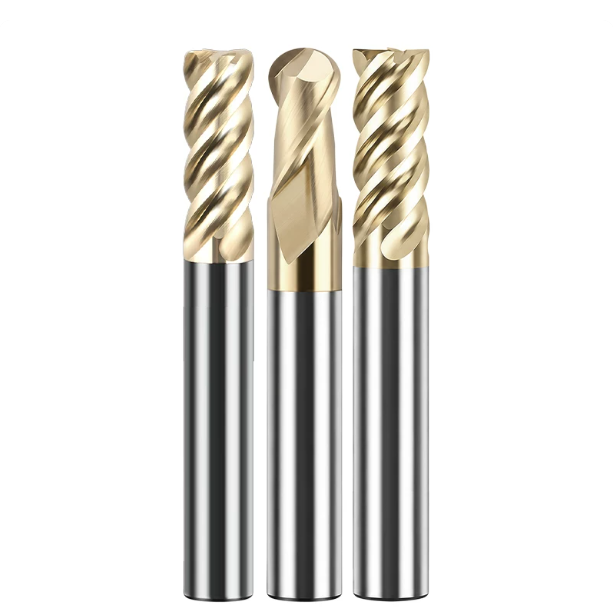
Vibration-Damping Mechanisms via Variable Helix and Unequal Pitch: The Geometric Secrets of High-End Solid Carbide End Mills
Because increasing tool holder rigidity cannot eliminate resonance, we must focus on the geometry of the cutting edge itself. The secret to dampening vibration in high-performance solid carbide end mills lies in disrupting the physical frequency of the cut. By altering the spatial distribution of the flutes, the tool prevents cyclic impact loads from building up during high-speed engagement in titanium.
Producing a titanium-milling cutter that withstands extreme heat and cutting resistance requires more than basic wheel grinding. We program multi-axis trajectories on 5-axis CNC grinders to integrate variable helix angles and unequal pitch into a single tool body. As the cutter spins at high RPM, the radial and axial forces dynamically fluctuate across each tooth, breaking the physical conditions required for chatter.
Unequal Pitch: Disrupting the Periodic Phase of Cutting Forces
Conventional milling cutters feature symmetrical 90° tooth spacing. However, when customizing specialized end mills for titanium, we adjust flute spacing to asymmetrical patterns like 88°-92°-88°-92°. Verified with high-precision optical systems on our grinders, this asymmetrical spacing breaks the uniform timing interval at which each cutting edge strikes the material.
For tough, elastic titanium alloys, this minor shift yields dramatic real-world performance gains. As the first tooth generates a minute force fluctuation, the following tooth enters at an irregular interval, halting amplitude buildup before it starts. In our custom tooling, unequal tooth pitch eliminates low-frequency knocking noise and prevents premature tool tip chipping.
Variable Helix: Altering Chip Evacuation Angles and Cutting Force Distribution
Beyond circumferential flute spacing, the helix angle along the tool’s Z-axis is equally critical for chatter suppression. While standard cutters feature a uniform helix (e.g., 35°), our high-performance CNC end mills for titanium use a staggered variable helix like 35°/38° or 38°/41°. This constantly alters the entry angle and chip evacuation path across different axial depths.
This geometry excels in heavy axial depth-of-cut (Ap) milling. When cutting Ti-6Al-4V, teeth at varying heights do not bite the material simultaneously or at the same angle, smoothing out peak cutting forces. During heavy side milling or deep slotting, the spindle sound stays remarkably steady, and chips evacuate smoothly without recutting.
Our On-Site Test Data: Constant Pitch vs. Variable Helix/Unequal Indexing CNC End Mills for Titanium
To give shop engineers objective data, we ran comparative tests on a 5-axis machining center using Ti-6Al-4V blocks. We evaluated a standard 4-flute, equal-pitch cutter against our variable-helix, unequal-pitch china carbide end mill under identical speeds and feeds. A wireless accelerometer attached to the spindle recorded vibration in real time.
The standard tool caused frequent G-value spikes and harsh chatter noise. Switching to our vibration-damping geometry reduced average vibration acceleration by over 60%. Surface finish jumped from a chatter-marked Ra 1.6μm down to a mirror-like Ra 0.4μm, while tool flank wear plummeted by nearly 70%.
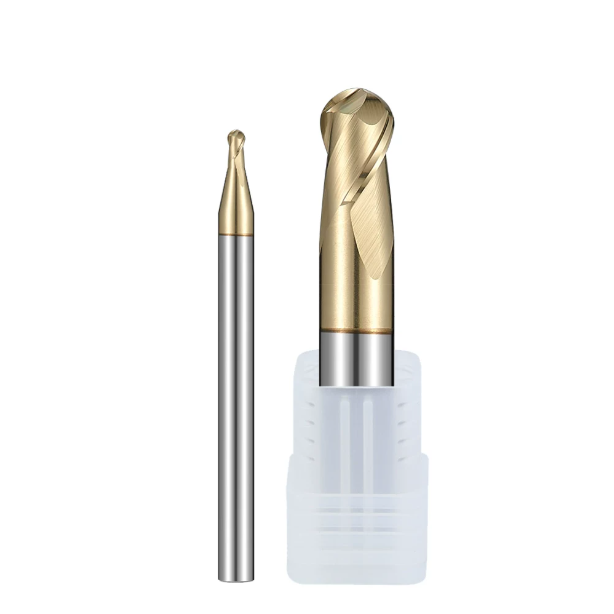
Tackling Complex Shapes and Deep Cavities: Applying This Technology to Ball Nose and Long-Neck End Mills
Contouring 3D surfaces and slotting deep cavities in titanium present massive machining challenges. Applying standard anti-vibration features directly to ball nose or long-neck tools often reduces tool-tip rigidity. Through extensive R&D, we found chatter on extended-reach tools concentrates at the radius transition zone and neck overhang, requiring targeted geometric decoupling.
Applying asymmetric variable helix angles and specialized flute spacing to custom solid carbide end mills extends vibration control to high-deflection zones. Whether you are milling aero-engine blades, orthopedic implants, or deep mold cavities, tailored tool geometry prevents gouging and restores precision in long-reach applications.
Vibration Control for Complex 3D Surfaces: Challenges and Real-World Application of Variable-Helix Ball Nose End Mills for Titanium
In 5-axis titanium milling, a major hurdle with ball nose tools is that cutting speed (Vc) drops near zero at the apex, causing material to tear rather than cut. As the contact point moves from the tip to the side edge, cutting forces spike violently. Uniform flute spacing in this transition zone almost always causes severe chatter and over-cut gouges.
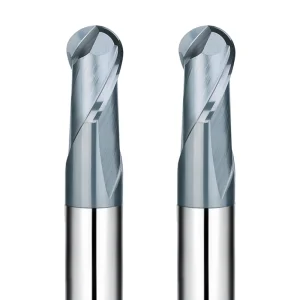
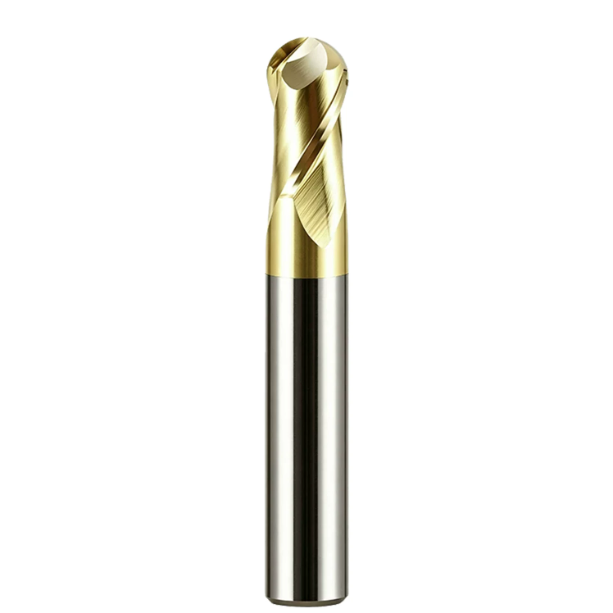
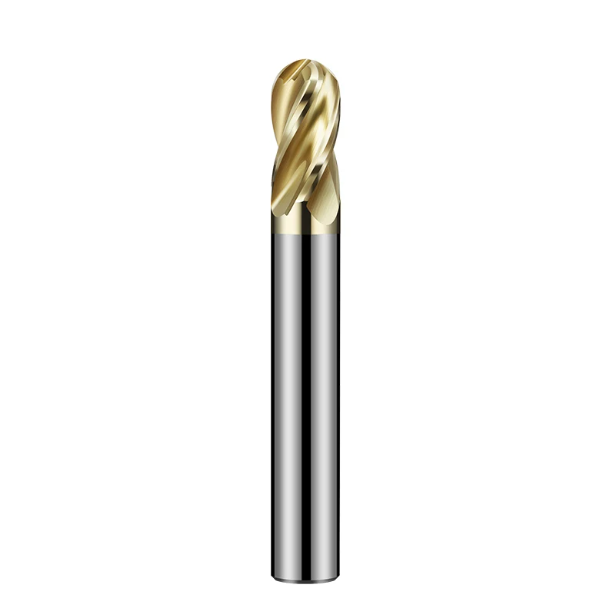
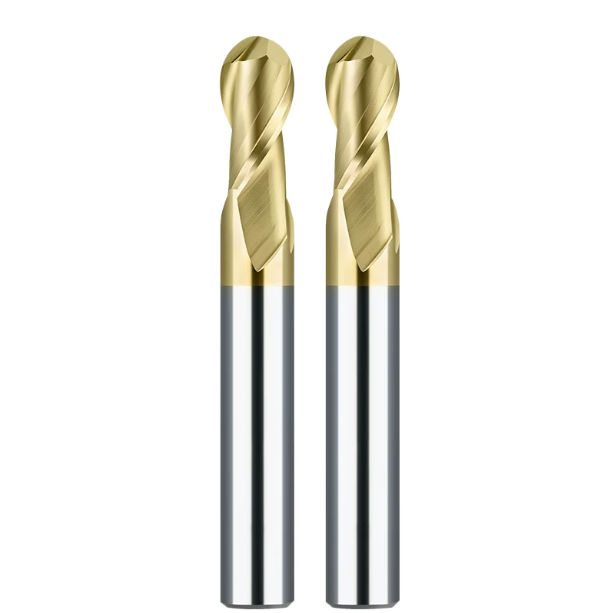
To solve this, we engineered a specialized ball nose end mill for titanium. On our 5-axis grinders, we apply a continuously varying helix angle across the spherical-to-straight edge transition and an asymmetric angle near the S-shaped center edge. This balances cutting forces dynamically across the radius, eliminating pressure spikes and harsh corner chatter.
Overcoming Tool Deflection in Deep Cavities: Vibration Damping and Clearance Geometry in Solid Carbide Long-Neck End Mills
When tool overhang exceeds 5D or 8D, long-neck tool rigidity drops precipitously, making deflection a constant headache. On the shop floor, extended overhangs magnify even minor cutting force fluctuations through leverage. This causes slot width deviations, loud resonance inside deep pockets, and sudden tool breakage at the neck.
We manufacture our long neck end mills using a combination of variable helix angles and unequal tooth spacing, paired with a tapered neck for maximum rigidity. The variable pitch disrupts low-frequency resonance, while the tapered clearance increases the tool’s bending resistance, allowing machinists to maintain aggressive feeds without fear of tool bounce.
Practical Cutting Parameters and Pitfall Avoidance: A Veteran Engineer’s Guide to Setting Up Titanium End Mills
Even advanced vibration-dampening geometry requires a smart cutting strategy to unlock its full potential. Over half of premature tool failures stem from improper programming and coolant usage rather than tool quality. Machinists accustomed to steel often use traditional “wide cut, shallow depth” paths on titanium, causing extreme heat buildup that quickly destroys cutting edges.
Optimizing specialized end mills for titanium requires balancing temperature control with cutting force management. Success comes down to managing chip thickness and controlling cutting heat. By adopting dynamic trochoidal milling and leveraging variable helix geometries for chip evacuation, you can break the frustrating cycle of low efficiency and constant tool changes.
Balancing Radial Depth of Cut (Ae) and Cutting Speed (Vc) in Trochoidal Milling
When helping overseas machine shops optimize cycle times, we frequently implement dynamic trochoidal milling. Instead of traditional slotting with 50% to 100% radial engagement (Ae), trochoidal paths use light radial engagement (Ae = 5%–10% D) combined with deep axial engagement (Ap = 1.5–2D). This brief engagement angle allows the cutting edge to cool between rotations.
Pairing this light engagement strategy with our precision-ground CNC end mills for titanium allows you to confidently increase cutting speed (Vc) by 30% to 50% without heat buildup. Our shop testing shows this approach boosts Metal Removal Rates (MRR) by over 200% while transferring heat into the chips, extending tool life significantly over conventional methods.
Titanium Cooling and Chip Control: Preventing High-Pressure Coolant from Disrupting Thermal Balance
Coolant application on titanium requires extreme care. We frequently see operators spraying external coolant nozzles directly at high-speed tools during heavy cuts. This subjects cutting tips—operating at near 1,000°C—to intense thermal shock. Rapid temperature cycling creates micro-fractures in the carbide substrate, leading to sudden edge flaking.
To prevent thermal shock, we strongly advocate using solid carbide end mills with through-tool coolant channels. Internal coolant at 70+ bar delivers fluid directly to the cutting zone, flushing sticky titanium chips through variable-helix flutes before heat builds up. If internal coolant isn’t available, air blasts or MQL often deliver better tool life than intermittent flood cooling.
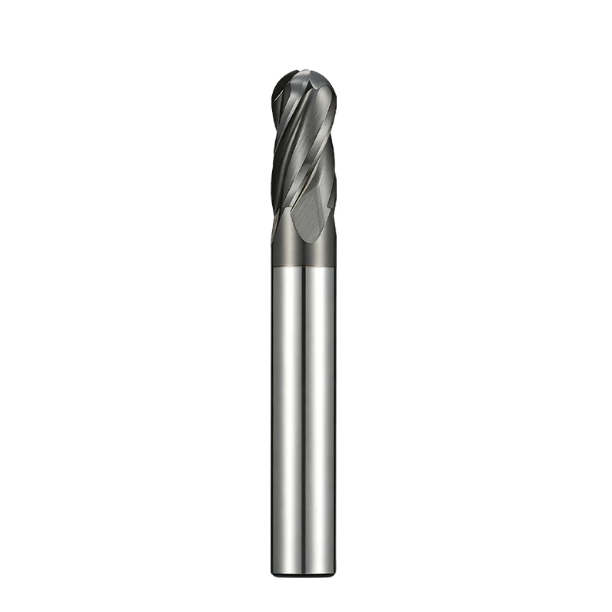
Dispelling Misconceptions: How We, as a Chinese End Mill Manufacturer, Ensure Consistent Production Capacity and Quality
Overseas engineers often express a complex attitude toward Chinese cutting tools: wanting the cost benefits while worrying about batch consistency. As established end mill manufacturers specializing in difficult-to-machine alloys, we understand these concerns. Top-tier performance is defined by raw material selection, machine hardware, and process controls rather than factory geography.
Delivering reliable performance on Ti-6Al-4V requires a closed-loop quality system. Every step—from carbide grain control and 5-axis CNC grinding to micro-edge honing and PVD coating—demands absolute precision. We compete directly with top Western brands because we enforce these rigorous technical standards across every tool leaving our facility.
Precision Control: Imported Carbide Rods and ANCA/Rollomatic 5-Axis Grinders
To eliminate concerns regarding the consistency of a china carbide end mill, we maintain complete transparency in our manufacturing process. We build our titanium tooling using European-imported 0.4μm ultra-fine grain carbide rods. This substrate offers exceptional Transverse Rupture Strength (TRS) and hardness, preventing micro-chipping under heavy cutting loads.
We program complex geometries—variable helix angles, unequal pitch, and corner radii—into ANCA and Rollomatic 5-axis CNC grinders for single-setup precision. Checked on Zoller optical measuring systems, we maintain outer diameter tolerances within ±0.005mm and runout under 0.003mm across a 500-piece batch, ensuring seamless tool swaps without parameter adjustments.
Coating and Edge Preparation—The Final Step Defining the Lifespan of Premium Titanium Milling Tools
Grinding complex geometry is only half the process. Freshly ground edges feature microscopic burrs that quickly chip under load, triggering coating delamination. To prevent this, we apply a micron-level edge honing process after grinding, creating a uniform micro-radius that dramatically enhances edge strength against heavy shock.
Following edge prep, we apply premium nACo or AlTiN nanocomposite coatings resistant to temperatures up to 1,100°C. These coatings feature extreme hardness, low friction, and superior oxidation resistance, preventing heat transfer into the carbide core and resisting built-up edge (BUE). This combination produces durable solid carbide end mills built for demanding titanium applications.
B2B Procurement & Trial Solutions: Replacing Tier-1 Brands with Our Cost-Effective Chinese Carbide End Mills
Maximizing titanium machining efficiency requires a multi-faceted strategy: resolving chatter through variable helix/unequal pitch geometries, tailoring rigidity for deep cavities, and optimizing trochoidal parameters with internal cooling. Balancing vibration-dampening geometry with cutting mechanics allows machine shops to achieve high throughput, extended tool life, and lower operational costs.
If you are struggling with chatter on titanium structural parts, deep slots, or complex 3D surfaces—or if high tooling costs are eroding your margins—we invite you to review your current bottlenecks. Send us your component drawings, titanium grades, and cutting data. Backed by 15 years of hands-on technical experience, our team will recommend optimized end mills for titanium and provide trial samples to boost your shop’s productivity.